The Illusion of Distance: Why Retreating to the Second Island Chain Could Surrender the Pacific
Distance once protected America. In the Indo-Pacific, it could become a liability.
That is the dangerous paradox at the heart of the growing argument for American retrenchment from Northeast Asia. Advocates of a reduced US footprint contend that Washington can scale back its commitments, withdraw forces toward the Second Island Chain and still preserve a favorable balance of power from afar.
It sounds like restraint. But restraint and deterrence are not synonymous.
The real question is brutally simple: If America leaves the front line, who fills the vacuum?
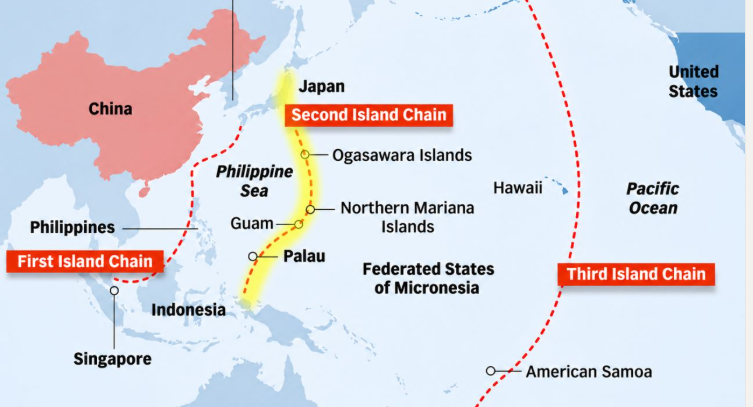
A proposal associated with Defense Priorities would go particularly far, ending longstanding US defense treaty commitments involving South Korea, Japan and the Philippines while shifting America's strategic center of gravity toward the Second Island Chain, including Guam, Palau and the Northern Mariana Islands.
Its appeal is understandable. Fewer forward commitments could mean reduced exposure, lower escalation risks and a smaller burden on American forces.
But geography cuts both ways.
The tyranny of distance
The Pacific is enormous. Maps make that obvious, but military operations make it unforgiving.
Aircraft require fuel. Ships require time. Munitions and spare parts must travel. Damaged equipment must be repaired. Reinforcement across thousands of kilometers is fundamentally different from having forces, infrastructure and logistics already positioned near the theater of crisis.
That distinction becomes particularly important in conflicts where the decisive phase could begin rapidly.
Long-range precision weapons, cyber operations, electronic warfare and increasingly sophisticated surveillance systems have compressed military decision-making. The opening period of a confrontation could therefore establish facts that become immensely expensive to reverse.
That creates the fait accompli problem.
Rather than defeating the United States across the Pacific, an adversary might seek a much narrower objective: move quickly, establish control over strategically important territory and then confront Washington with an ugly choice.
Accept the new reality, or fight to reverse it.
In that scenario, an ocean is not necessarily a shield. It is time.
And time belongs to whoever has already arrived.
Deterrence is also psychological
Forward deployment does more than reduce response times. It sends a political message.
Troops, ships, aircraft, logistics networks and permanent infrastructure communicate that alliances are not simply diplomatic language. They demonstrate that a crisis involving an ally would immediately involve American interests as well.
Retrenchment changes that calculation.
This does not mean every withdrawal automatically causes aggression, nor that more forward forces always produce greater stability. Large deployments can create their own vulnerabilities and escalation risks.
But deterrence ultimately depends on an opponent believing both that you can respond and that you will.
Distance inevitably complicates the first half of that equation.
Doubts about the second can be even more dangerous.
The nuclear question
Then comes the consequence strategists should fear most: what America's allies might do if they conclude that the American security guarantee is no longer dependable.
Countries do not outsource existential security because it is fashionable. They do so because they trust an alliance more than they fear dependence upon it.
Break that confidence and strategic calculations change.
Debates over greater military self-reliance could intensify. Conventional forces could expand. Domestic discussions about nuclear options could become harder to dismiss.
A policy designed to reduce American commitments could therefore produce an Indo-Pacific that is not less militarized, but dramatically more so.
The forward edge
The debate should not be caricatured as a choice between endless American expansion and total retreat. Washington can demand greater burden-sharing, disperse vulnerable bases and strengthen allied capabilities without erasing the strategic value of forward presence.
Indeed, the smarter response to increasingly lethal missile environments may be dispersion rather than disappearance.
That is the central weakness in treating the Second Island Chain as sanctuary.
Oceans create distance. They do not automatically create deterrence.
And if the United States abandons strategic terrain only to discover after a crisis that it needs that terrain back, the price of returning could dwarf the price of staying.
The most dangerous battlefield may be the one you voluntarily leave before the shooting starts.