The Billion-Euro German Drone Mirage
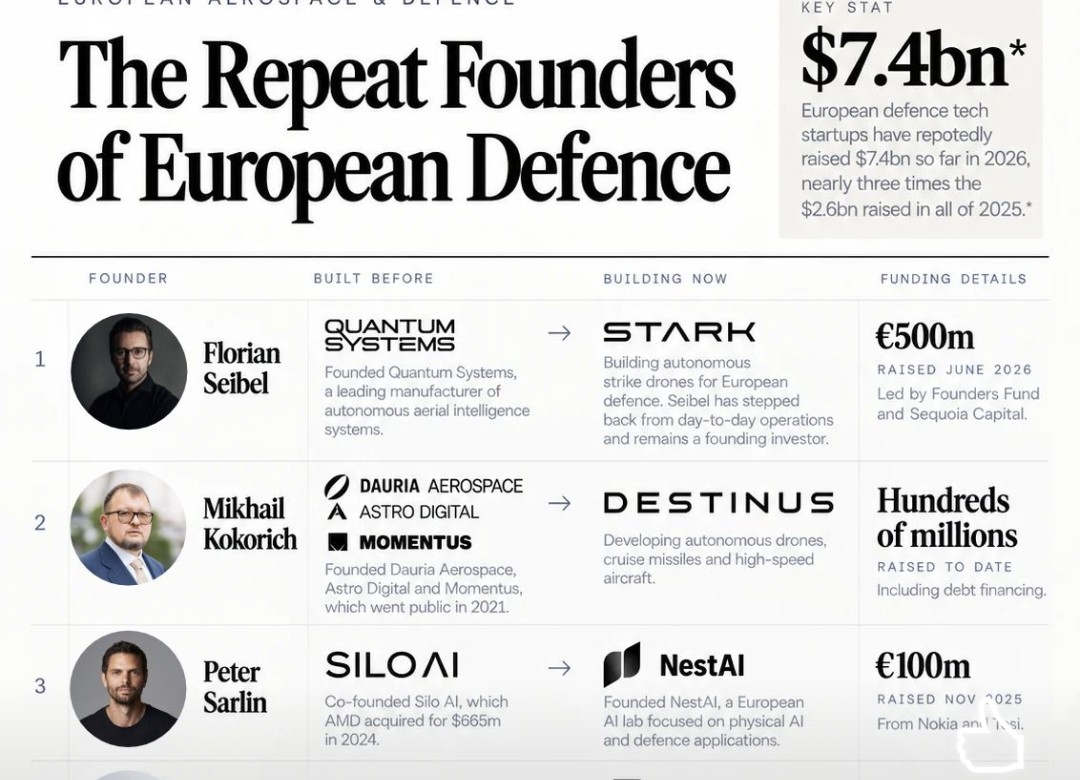
Europe’s defence-tech boom is creating unicorns at extraordinary speed. But behind the billion-euro valuations, the financial reality is often far less spectacular.
Something unusual is happening in European defence technology.
Companies that only a few years ago were small startups are suddenly being discussed as multi-billion-euro businesses. Funding rounds are getting larger, military contracts are making headlines, and investors are competing for exposure to drones, artificial intelligence and autonomous weapons.
Germany has become one of the centres of this new defence-tech economy.
But there is a problem.
When reading the headlines, it is increasingly difficult to understand what the numbers actually mean.
A company raises €500 million and suddenly appears to be a €3.5 billion business. Another raises more than a billion and receives a valuation measured in many billions. A framework agreement worth hundreds of millions is announced and can easily sound like hundreds of millions in sales.
Funding becomes confused with revenue. Valuation becomes confused with company value. Potential contracts become confused with actual business.
None of this necessarily means that companies are lying.
It means that European defence tech has become exceptionally good at selling tomorrow’s success today.
The three numbers that marketing loves to mix
There are three fundamentally different numbers in the startup world.
The first is funding: money investors put into a company.
The second is valuation: the theoretical value assigned to the company when those investors purchase shares.
The third is revenue: money actually earned from customers.
They sound similar in a LinkedIn post. Economically, they are completely different.
If investors put €500 million into a startup at a €3.5 billion valuation, the company has not earned €3.5 billion. It has not even earned €500 million.
It has sold investors part of a story about its future.
And nowhere is that future currently more valuable than in European defence.
Quantum Systems: probably the strongest case
Quantum Systems is important because it demonstrates that not every spectacular defence valuation is built on air.
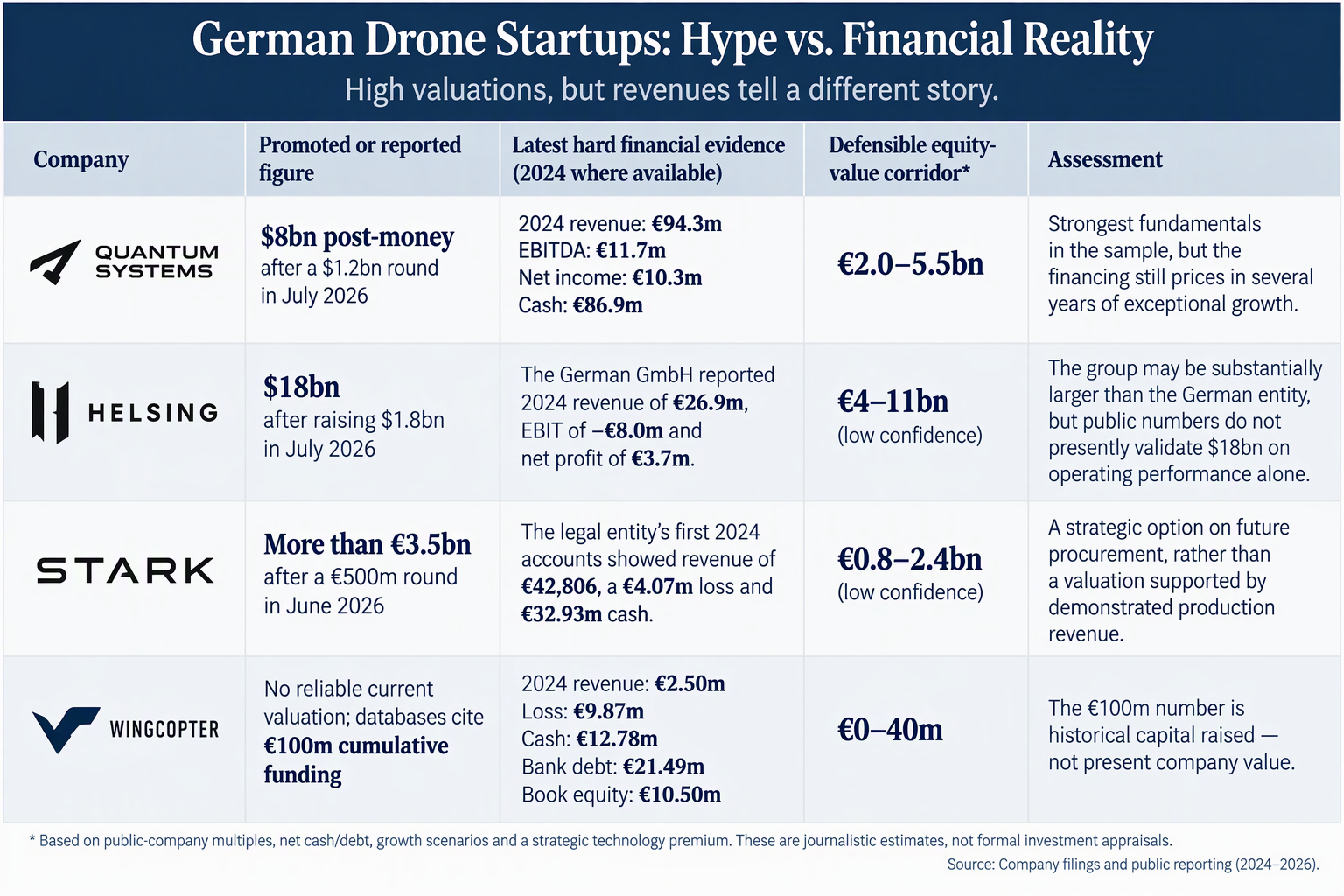
The German drone manufacturer reported roughly €94 million in 2024 revenue and was profitable. That is genuine industrial performance.
But the investment story subsequently accelerated much faster than the accounts.
By 2026, a major financing round reportedly valued the company at around $8 billion.
Could Quantum Systems eventually be worth that?
Absolutely.
Does €94 million of historical revenue justify an $8 billion company?
Not by itself.
A more conventional financial interpretation would probably put the business several billion euros below the headline valuation, unless revenue has exploded since the last available accounts.
Investors therefore aren't really buying the company visible in the rear-view mirror.
They are buying the possibility that Quantum Systems becomes one of Europe's dominant autonomous defence companies.
That's a very different investment proposition.
Helsing: when profit isn't quite what it seems
Helsing provides an even more interesting example.
The company has become one of Europe's most prominent defence-AI businesses and achieved an enormous private-market valuation.
Yet the financial details tell a more nuanced story.
The German company generated approximately €27 million of revenue in its 2024 accounts and recorded an operating loss of roughly €8 million.
Nevertheless, it finished with a net profit.
How?
A significant reason was interest income.
After raising hundreds of millions from investors, the business had a very large amount of cash. That cash itself generated substantial interest.
There is nothing improper about that. It is perfectly legitimate accounting.
But it illustrates why headlines such as"profitable defence-tech company" need to be approached carefully.
There is a major difference between making money by selling technology and making money because hundreds of millions of investor euros are sitting in interest-bearing accounts.
Helsing may eventually justify its spectacular valuation. Its technology could become deeply embedded in European defence infrastructure.
But the valuation presently reflects far more than demonstrated earnings.
It reflects strategic importance, intellectual property, expected contracts and, above all, expectation.
STARK: the most extraordinary gap
Then there is STARK.
This may be the purest example of the new defence-tech economy.
The company's underlying legal entity reported only around €43,000 of revenue in its first published 2024 accounts, alongside a multimillion-euro loss.
Two years later, investors reportedly valued the company at more than €3.5 billion.
Read those numbers again.
Thousands in reported early-stage revenue.
Billions in valuation.
Of course, comparing them directly isn't entirely fair. STARK subsequently developed rapidly, raised significant capital and attracted major military business.
But that is exactly the point.
The valuation isn't really describing what STARK has been.
It describes what investors believe STARK could become.
There is an enormous difference between building an impressive military drone prototype and becoming a mature defence manufacturer capable of producing thousands of systems reliably, profitably and on schedule.
The €3.5 billion valuation effectively assumes that a substantial part of that journey will succeed.
And then there is Wingcopter
The civilian drone industry provides an uncomfortable reality check.
Wingcopter has developed sophisticated delivery-drone technology and attracted considerable investment.
But developing aircraft is expensive.
Its 2024 numbers showed only around €2.5 million in revenue against a loss approaching €10 million. Debt was substantial relative to cash.
Over its lifetime, the company has reportedly attracted approximately €100 million in funding.
And here we encounter another common misunderstanding.
€100 million raised does not mean a company is worth €100 million.
The money may already have been spent.
Engineers were paid. Aircraft were developed. Certification was pursued. Prototypes were manufactured. Offices operated.
Startup funding is fuel.
When the fuel has been burned, you cannot count it again as the value of the aircraft.
Defence has changed the economics
There is nevertheless a reason investors are willing to accept apparently absurd valuations.
Europe has changed.
Governments are increasing defence expenditure. Ukraine has demonstrated the strategic importance of inexpensive autonomous systems. Militaries that once ordered slowly are suddenly looking for drones, artificial intelligence, electronic warfare and autonomous weapons at scale.
Investors are therefore no longer valuing these companies like ordinary manufacturers.
They are valuing them as potential future European defence champions.
If a €3 billion startup eventually becomes Europe's equivalent of a major defence prime, today's valuation could look cheap.
If it remains a technologically impressive company with modest production volumes, today's valuation could look extraordinary.
The distance between those outcomes is enormous.
And that distance is where marketing lives.
The billion-euro optical illusion
The real problem therefore isn't necessarily false accounting.
It is presentation.
A startup announces:
€500 million raised.
A journalist adds:
€3.5 billion valuation.
The company mentions:
€1 billion framework agreement.
Social media places all three figures next to photographs of autonomous weapons.
The reader sees billions, billions and more billions.
What the reader may not see is:
actual annual revenue: perhaps tens of millions.
Or:
operating profit: negative.
Or:
guaranteed orders: considerably smaller than the framework ceiling.
Every individual number can be technically correct while the overall impression becomes economically misleading.
That is what makes modern defence-tech marketing so effective.
So are German drone manufacturers exaggerating their value?
Not necessarily.
Calling the valuations "fake" would go too far.
Investors really are paying prices that imply these enormous valuations. Governments really are placing substantial orders. European defence spending really is changing.
But investors are valuing something fundamentally different from accountants.
Accountants price the past.
Venture capital prices the future.
And defence-tech investors are currently pricing a particularly dramatic future.
That's why a startup with relatively modest historical sales can suddenly become a multi-billion-euro company.
It isn't necessarily financial fiction.
But neither is it proof that the business has already achieved what its valuation implies.
That distinction is too often lost.
Europe's most valuable defence product may currently be expectation
Germany's new drone companies could become enormous industrial successes.
Some probably will.
Quantum Systems already demonstrates meaningful revenue and profitability. Helsing could become an important European defence-software platform. STARK could turn early battlefield technology into industrial-scale production.
But those are still sentences containing the words could and become.
Capital markets have already removed those words from the valuation.
That is perhaps the most fascinating aspect of Europe's defence-tech boom.
The factories are coming.
The contracts may grow.
The drones may be produced by the thousands.
The profits may eventually follow.
The billion-euro valuation, however, has already arrived.