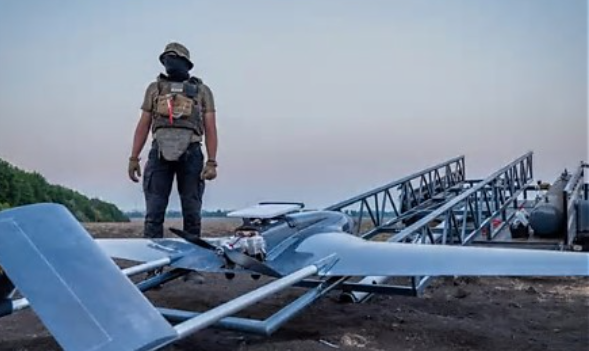
46 Missions Instead of Five: The Ground Robot That Exposed the Future of Warfare

Modern warfare has a brutal economic reality.
The battlefield is becoming increasingly deadly not only for soldiers, but for logistics.
Ammunition must move.
Water must move.
Food must move.
Medical evacuations must happen.
Yet on many sections of the Ukrainian front, reaching positions with conventional vehicles has become extraordinarily dangerous because of pervasive drone surveillance and attack systems.
This is where the story of GEREON, a ground robotic platform developed by ARX Robotics, becomes interesting. Not because it is another military robot. The battlefield is already full of robotic experiments. But because it appears to have achieved something exceptionally rare: operational endurance under real combat conditions.
According to operators from the Chervona Kalyna Brigade, a single GEREON platform completed 46 combat missions over approximately two months. By comparison, soldiers described the average battlefield life expectancy of many ground robotic systems as roughly five missions.
That difference is not incremental.
It is transformational.
The Logistics Revolution Nobody Talks About
Military innovation discussions are often dominated by dramatic technologies.
Hypersonic missiles.
AI-powered drones.
Electronic warfare.
Space assets.
Yet wars are still ultimately won or lost through logistics.
Armies fight on ammunition deliveries.
Not PowerPoint presentations.
The GEREON's primary role was not attacking enemy positions. Instead, it delivered supplies to locations where traditional vehicles could no longer operate safely because of Russian drone activity.
Across dozens of missions, the platform reportedly transported nearly 25 tonnes of cargo including ammunition, food, water, and other critical supplies.
That may not generate dramatic headlines.
But it solves one of the most important problems of modern warfare: sustaining troops without exposing additional personnel to danger.
When Survival Becomes the Capability
Military procurement discussions frequently focus on specifications.
Payload.
Speed.
Range.
Autonomy.
Sensor suites.
Ukraine continues to reveal a different truth.
The most important battlefield specification may simply be survival.
A robot that survives 46 missions is more valuable than a technologically superior machine destroyed after four.
One of the most remarkable aspects of the GEREON story is how little maintenance it required.
According to operators, the platform needed only one repair during its operational life after falling into an anti-tank ditch and damaging a structural support component. The damaged element was repaired and the vehicle returned to service.
In military terms, reliability creates operational trust.
And trust drives adoption.
From Supply Runs to Casualty Evacuation
Perhaps the most telling moment was not related to logistics at all.
The platform was reportedly used to evacuate two wounded soldiers who could not move independently. The robot reached the casualties, transported them, and delivered them to safety.
This highlights a broader trend emerging across modern military robotics.
Platforms initially designed for logistics increasingly evolve into multi-role systems.
Supply transport.
Casualty evacuation.
Reconnaissance.
Communications support.
Remote payload deployment.
Robotics on the battlefield are beginning to resemble smartphones: flexible platforms capable of performing multiple missions rather than single-purpose machines.
The Real Product Is Learning
The most valuable outcome may not have been the missions themselves.
It was the data.
According to ARX Robotics, extensive operational use generated significant insights into platform performance under real combat conditions, insights that are being incorporated into future system generations.
Notably, newer versions already include hardware modifications, upgraded cameras, and enhanced communications features, including voice communication capabilities between operators, frontline personnel, and potentially wounded soldiers during evacuation scenarios.
This points toward an increasingly important characteristic of modern military technology.
The competitive advantage is not hardware.
It is learning speed.
Every mission becomes feedback.
Every deployment becomes software improvement.
Every loss becomes engineering input.
The Future Arrived Quietly
In the end, the robot did not fail.
It was destroyed when an air strike hit the shelter where it was stored before its next mission. After successfully completing 46 operations, the platform never made it to number 47.
Yet its significance extends beyond one machine.
The story demonstrates that robotics are moving beyond experimentation and becoming operational infrastructure.
The future battlefield may not be defined by the robots that fight.
It may be defined by the robots that ensure everything else keeps fighting.
And that future has already arrived.