44 Kilometres Across the Dnipro: Ukraine Is Turning Tactical Radios Into Battlefield Networks
Forty-four kilometres does not sound revolutionary in the age of satellites.
On a battlefield, it can be.
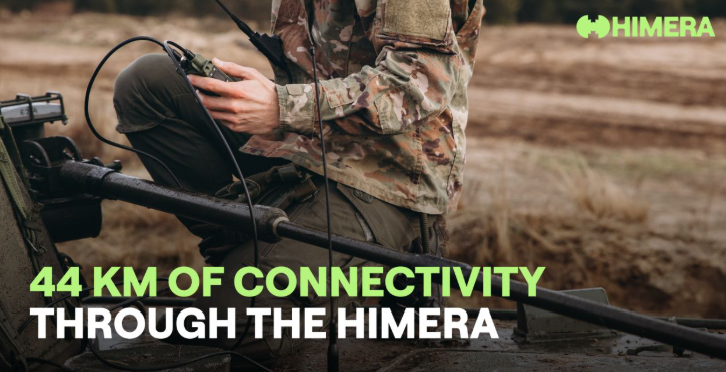
Ukrainian defence technology company HIMERA says it has tested a tactical radio network spanning 44 kilometres in the Zaporizhzhia direction, deploying communications across the Dnipro River from the right bank toward the left. The test was conducted together with a Ukrainian military unit and focused on providing connectivity across terrain exposed after the former Kakhovka Reservoir was drained.
But the real story isn't the distance.
It is how the distance was created.
During the trials, a HIMERA G1 PRO radio communicated with a B1 repeater across 24 km. Another link, between an R1 repeater and a G1 PRO, reached 20 km. The complete G1 PRO → R1 → G1 PRO configuration extended the network to 44 km, according to the manufacturer.
Traditional discussion about tactical radios often focuses on the range of an individual device. But modern battlefield communications increasingly concern the resilience and adaptability of the network.
A radio does not necessarily have to reach every soldier directly if information can move intelligently through intermediate nodes.
That is the logic behind the mesh/MANET architecture HIMERA says it is developing. Devices can operate as part of a network in which information is relayed through other nodes, allowing units to configure communications around their mission and terrain.
The network becomes the weapon system.
Ukraine is an unusually demanding laboratory for that idea.
Modern communications operate in an environment where connectivity can be disrupted, geography can obstruct line-of-sight links and individual network elements cannot simply be assumed to remain continuously available.
Mesh architectures approach the problem differently. Instead of treating every radio as the endpoint of a rigid communications chain, individual devices can contribute to a wider network.
Previous Ukrainian testing underlines the concept. In 2025, a Ukrainian Territorial Defense formation reportedly tested four G1 PRO radios in mesh mode and achieved communications across 45 km without additional equipment, with individual radios acting as relay nodes.
The latest Zaporizhzhia trial adds another dimension: dedicated repeaters alongside handheld radios.
And perhaps the most important element is not visible on a specification sheet at all.
HIMERA says the testing was conducted with Ukrainian servicemembers specifically so that performance could be evaluated under practical conditions and the equipment improved around the needs of Ukraine's Defence Forces.
That is becoming one of Ukraine's most consequential defence-industrial advantages.
The development loop is brutally short.
Build.
Test.
Put the technology into realistic military conditions.
Discover what fails.
Change it.
Test again.
Western defence procurement traditionally prizes requirements, certification and carefully controlled development programmes. Ukraine's wartime ecosystem has added another metric: how quickly can technology absorb reality?
That does not mean a 44 km field test proves that identical performance will occur everywhere. Radio performance remains dependent on configuration, terrain, antenna positioning and operational conditions. The result should therefore be understood for what it is: a reported test outcome in a particular configuration, not a universal range guarantee.
Yet that actually makes the experiment more interesting.
The future of tactical communications may not belong to the radio boasting the biggest range on a brochure.
It may belong to the network capable of rebuilding the path when the battlefield breaks it.
Forty-four kilometres is the headline.
Adaptability is the story.