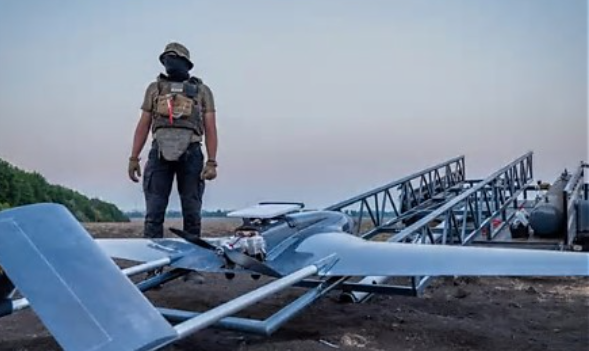
The Runway Is Moving: TEKEVER’s AR5 Just Took Naval Autonomy Out to Sea
For more than a century, the aircraft carrier has represented one of the most difficult operating environments in aviation. The runway moves. The deck pitches. Space is brutally limited. And mistakes at sea are expensive.
Now add autonomy.
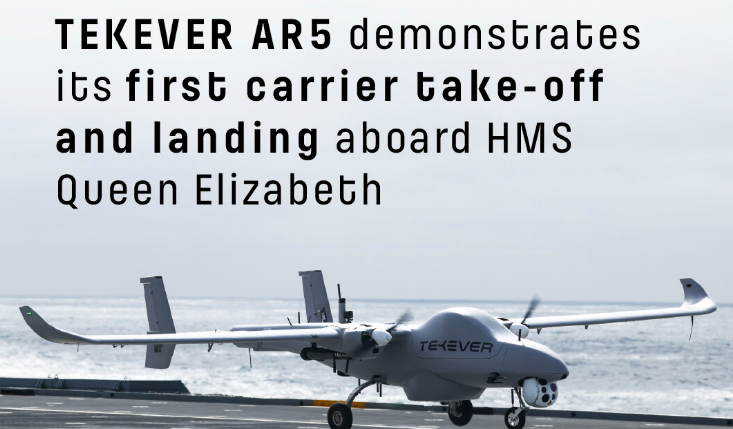
In a striking demonstration of where naval aviation may be heading, TEKEVER’s AR5 operated from the flight deck of HMS Queen Elizabeth during Heavy Lift Challenge 3, marking the first time an AR5 had operated from a Royal Navy carrier.
That is more than an interesting drone test. It touches on a much bigger question facing modern navies:
What happens when a carrier no longer launches only crewed aircraft, but becomes a floating hub for autonomous systems?
A drone meets a moving runway
After take-off, the AR5 conducted an autonomous approach to HMS Queen Elizabeth. The system then completed two landings and two take-offs from the flight deck before returning to land.
The significance lies in the environment.
Operating a fixed-wing uncrewed aircraft from a carrier is fundamentally different from launching one from a conventional airfield. A carrier is a mobile, constrained platform operating inside a complex maritime ecosystem.
Demonstrating launch and recovery at sea therefore opens possibilities far beyond simply putting another aircraft on a ship.
The AR5 could potentially extend a naval force's reach in logistics, sustainment and intelligence, surveillance, target acquisition and reconnaissance, or ISTAR.
That combination matters.
A carrier group needs information, supplies and persistent awareness across an enormous operating area. Traditionally, many of those missions depend on valuable crewed platforms, helicopters or other scarce assets.
Autonomous fixed-wing systems introduce another option.
The real disruption may be operational
The most interesting part of naval autonomy is not necessarily replacing an existing aircraft with an uncrewed version.
It is changing what commanders can afford to do repeatedly.
A system capable of operating from ships could potentially undertake persistent surveillance, move urgently needed payloads between locations or support missions in situations where committing a crewed aircraft is inefficient or exposes personnel to unnecessary risk.
That could create a different equation for naval aviation: distribute capability across more platforms, increase persistence and reserve premium crewed assets for missions where human presence brings the greatest value.
The Heavy Lift Challenge also considered how the AR5 might operate alongside other systems within a carrier group. That is critical.
The future carrier may not simply host jets, helicopters and a few drones. It could increasingly function as an orchestrator of crewed and uncrewed systems, with different platforms sharing sensing, logistics and operational tasks.
From experiment to doctrine
There is, of course, an important distinction between a successful demonstration and routine operational deployment.
Real naval environments impose difficult requirements around weather, communications, deck management, integration, safety, maintenance and interoperability. Proving a capability during trials is only one step toward embedding it into everyday naval operations.
But demonstrations matter because they make previously theoretical concepts tangible.
Heavy Lift Challenge 3 also brought together the Royal Navy, British Army, Royal Air Force and industry partners. That collaboration is revealing in itself. Autonomous systems increasingly cut across traditional boundaries between air, land and maritime forces.
And that may be the bigger story here.
The AR5 did not merely demonstrate that an autonomous aircraft could approach, land on and depart from a carrier.
It offered a glimpse of a naval model in which the aircraft carrier is no longer simply a floating airfield.
It becomes a node in an autonomous network.
The runway is still moving.
Now, increasingly, the aircraft can think about how to reach it.