The Procurement Scapegoat: Why Defence Innovation Fails Long Before the Contract Is Signed
In defence circles, a familiar complaint has become almost impossible to avoid.
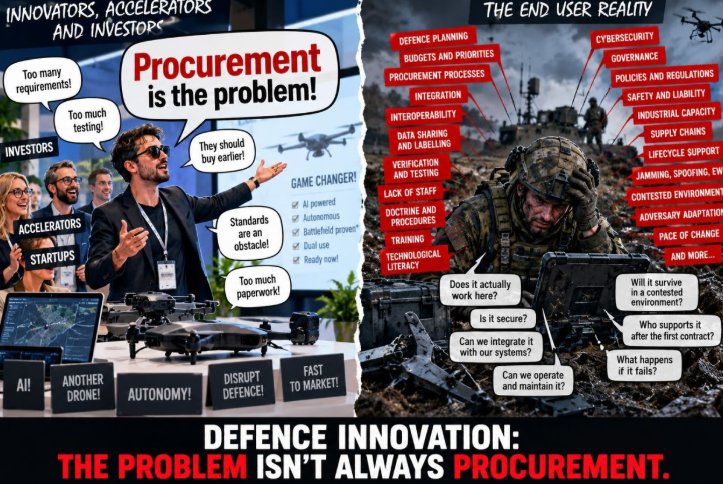
Innovation is too slow because procurement is too slow.
If governments bought faster, startups would thrive. If military requirements were simpler, innovation would flourish. If standards, certification, testing, cybersecurity reviews, and bureaucracy disappeared, revolutionary technologies would rapidly transform Europe's armed forces.
It's an attractive narrative.
It's also incomplete.
And increasingly, military users are growing tired of hearing it.
Because many technologies fail long before procurement ever becomes the obstacle.
The Silicon Valley Fantasy Meets Military Reality
A growing number of entrepreneurs enter defence with the mindset that transformed commercial markets.
Move fast.
Disrupt incumbents.
Scale aggressively.
Win customers.
The problem is that defence is not a consumer market.
Military organizations do not buy products because they are technologically impressive.
They buy capabilities because they solve operational problems.
That distinction sounds obvious.
Yet countless startups still approach armed forces with a technology looking for a mission rather than a mission demanding a technology.
Artificial intelligence.
Autonomy.
Computer vision.
Drone swarms.
Generative AI.
The buzzwords change every year.
The question does not.
What military problem are you solving?
Not what technology have you built.
Not how much venture capital you've raised.
Not how many headlines you've generated.
What operational requirement does it address?
The Battle Doesn't Care About Your Pitch Deck
Military users operate in environments fundamentally different from commercial customers.
Systems face jamming.
GPS denial.
Cyber attacks.
Electronic warfare.
Supply shortages.
Extreme weather.
Maintenance constraints.
Human stress.
Enemy adaptation.
The battlefield is an extraordinarily hostile product-testing environment.
A startup can demonstrate impressive performance in a laboratory, exhibition hall, or controlled trial.
That says surprisingly little about how the capability will perform during actual military operations.
The difference between "works" and "works in combat" is where many innovations fail.
And procurement departments are often blamed for discovering exactly that.
Bureaucracy or Operational Survival?
Critics frequently point to requirements, testing, certification, cybersecurity reviews, and interoperability standards as evidence of bureaucratic resistance.
Sometimes those criticisms are valid.
Defence organizations should absolutely streamline unnecessary processes.
But there is a dangerous misunderstanding at the heart of many complaints.
Not all bureaucracy exists because governments enjoy bureaucracy.
Some exists because failure carries consequences measured in lives rather than inconvenience.
A software failure in a commercial application might frustrate customers.
A software failure in an integrated military command system could compromise an operation.
An insecure network connection might create vulnerabilities.
An unreliable autonomous platform might place personnel at greater risk.
A poorly integrated component can affect an entire system-of-systems architecture.
These risks are not theoretical.
They are operational realities.
That is why assurance matters.
The Ukraine Problem
Another common phenomenon has emerged across Europe's defence innovation ecosystem.
Companies often claim battlefield relevance after brief exposure to Ukraine or secondary observations of the conflict.
The assumption is dangerous.
Modern warfare changes rapidly.
What worked six months ago may fail today.
Adversaries learn.
Countermeasures evolve.
Tactics shift.
Requirements change.
Understanding the battlefield requires sustained engagement with operators, lessons learned, logistics realities, electronic warfare conditions, and operational feedback loops.
Reading about a war is not the same as understanding it.
Visiting one is not the same as learning from it.
And neither automatically translates into useful military capability.
Innovation Requires Partnership, Not Blame
None of this means procurement is perfect.
Far from it.
European defence procurement remains fragmented.
Acquisition timelines remain lengthy.
Technology adoption often struggles to match the speed of innovation.
These are serious challenges.
But solutions will not emerge by treating procurement as the sole obstacle.
The most successful defence innovators share one characteristic:
They listen before they build.
They spend time with operators.
They study doctrine.
They understand logistics.
They learn the realities of integration.
They recognize that defence is not merely another technology sector waiting for disruption.
It is a mission-driven environment where effectiveness matters more than novelty.
The future of European defence will certainly require faster procurement.
It will also require something less frequently discussed:
Innovators who understand that building technology for the military starts with understanding the military itself.
Until that happens, many products will continue failing long before the procurement process ever gets a chance to reject them.