Germany’s Silent Steel: Inside the RDX 1 Ground Drone That Wants to Lead Soldiers Into Danger

The battlefield has spent decades evolving in the sky. Drones transformed reconnaissance, artillery targeting, and strike operations. Now the revolution is moving to the ground, and a little-known German startup believes it has built a machine that could fundamentally change how soldiers fight, move, and survive.
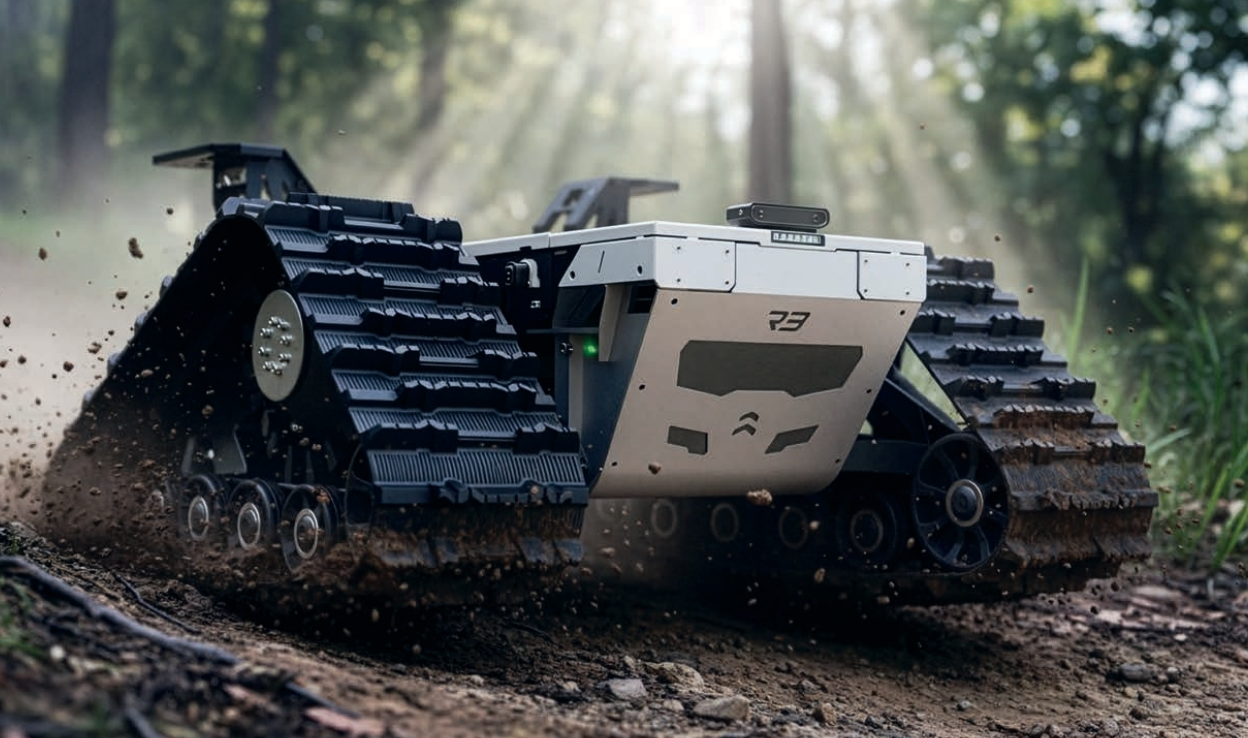
Last week, Munich-area defense startup Reactive Dynamics conducted its first tactical troop trials with the RDX 1, a tracked unmanned ground vehicle designed to perform some of the military's most dangerous tasks before a human ever steps into harm's way. According to the company, soldiers tested the platform in logistics missions, casualty evacuation, day-and-night reconnaissance patrols, and a particularly provocative role: acting as the lead vehicle ahead of manned forces.
The implications are significant.
For generations, soldiers have been the first to enter uncertain terrain. They have driven into potential ambush zones, crossed roads that may contain mines, and pushed forward into areas where enemy positions remained unknown. The RDX 1 proposes a different approach. Instead of risking human lives during the first contact phase, commanders could send an unmanned platform ahead to absorb the danger.
The concept may sound futuristic, but war has a way of accelerating innovation.
Ukraine's battlefields have already demonstrated that robotic systems are no longer experimental curiosities. They are rapidly becoming essential military tools. Unmanned aerial vehicles dominate the skies, while ground robots increasingly transport ammunition, deliver supplies, and retrieve wounded soldiers from exposed positions. Military planners across Europe have taken notice.
Against this backdrop, the RDX 1 enters an increasingly competitive but strategically important market.
On paper, the vehicle is impressive. Reactive Dynamics says its fully electric tracked platform can reach speeds of up to 80 km/h, travel 150 kilometers on a single charge, and carry payloads of up to 1,200 kilograms. Those figures place it among the more capable unmanned ground vehicles currently emerging from Europe's growing defense technology sector.
Yet raw performance numbers are only part of the story.
Perhaps the most interesting aspect of the RDX 1 is its electric drivetrain. In an age when thermal sensors and acoustic detection systems are everywhere, reducing heat and noise emissions can be just as important as armor or speed. A vehicle that is harder to detect presents obvious tactical advantages for reconnaissance missions, resupply operations, and casualty recovery under enemy observation.
For now, the RDX 1 remains remotely operated. But Reactive Dynamics has bigger ambitions. The company plans to introduce increasingly autonomous capabilities through software updates, gradually transforming the platform from a remotely controlled machine into something closer to an independent robotic teammate.
That vision becomes even more ambitious in what Reactive Dynamics calls the "Reactive Squad." Instead of deploying a single ground robot, military units could operate multiple unmanned vehicles equipped with different payloads under the supervision of a single operator. One platform could carry supplies, another conduct surveillance, while a third provides force protection. Together they would function as a coordinated robotic formation supporting human troops.
If successful, the concept could alter the very structure of ground maneuver operations.
The timing is notable. European governments are pouring billions into defense modernization, driven by growing security concerns and hard lessons emerging from modern conflicts. Startups that would have struggled to attract military attention a decade ago are now finding receptive audiences among defense ministries searching for technological advantages.
Reactive Dynamics is not alone. Germany's defense-tech ecosystem is producing a new generation of robotics companies racing to define the future of land warfare. The contest is no longer about whether unmanned ground vehicles will become standard equipment. The real question is which companies will establish themselves before the market matures.
The RDX 1's first troop trials do not guarantee success. Many promising defense technologies fail to transition from demonstrations to widespread deployment. But the direction is unmistakable.
The age of sending humans first is being challenged.
And on future battlefields, the first tracks crossing dangerous ground may belong not to a soldier, but to a robot.