When Electronic Warfare Fails, Throw a Net: DRONOLAW Takes Aim at the FPV Threat

The drone war has produced increasingly sophisticated jammers, sensors and interceptors. But what happens when the drone cannot simply be jammed?
You throw a net at it.
It sounds almost primitive. That is exactly what makes DRONOLAW interesting.
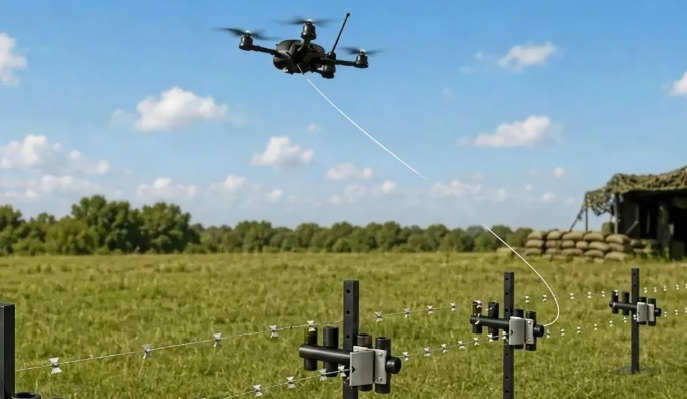
The international volunteer initiative DroneAid is developing an active protection system designed to defend vehicles and positions against FPV drones by physically entangling them in nets. The project was presented by Vadym Vasylenko, a DroneAid representative, at the Future Forces Forum in Prague.
The concept turns one of the simplest barriers imaginable into an automated last line of defence.
According to the information presented, DRONOLAW combines a central detection unit with a rotating assembly carrying launch containers. At the top sits an optical detection module equipped with a thermal-imaging camera. Beneath it, angled launchers fire nets toward approaching drones.
The claimed numbers reveal the philosophy behind the system.
DRONOLAW is designed to scan through 360 degrees in five seconds and detect aerial targets at distances of up to 100 metres. Actual interception takes place much closer, at approximately 10 to 20 metres, where a launched net is intended to entangle the drone's propellers.
That is remarkably close.
And deliberately so.
This isn't an Iron Dome for FPVs. It is closer to a technological goalkeeper: detect, track, wait and stop the attacker before impact.
Why build something so unconventional?
Fiber-optic FPV drones.
According to the developer, the emergence of fiber-optic-controlled drones drove the development of DRONOLAW. Unlike conventional radio-controlled FPVs, such drones create a particular challenge for electronic warfare because their control link is carried through a physical fiber rather than relying on the kind of radio connection that traditional jamming targets.
So DroneAid explored a different route.
Vasylenko said the team evaluated several detection technologies, including acoustic sensors, conventional cameras, thermal imaging, lidar and radar, before selecting thermal imaging as the preferred approach.
The thermal camera also allows detection around the clock, according to the developer.
But DRONOLAW isn't intended only for a static position.
Its optical system is stabilized, and the developers say the system can therefore be mounted on armored vehicles, ordinary motor vehicles and unmanned ground vehicles while maintaining image quality during movement.
That potentially matters enormously on an FPV-saturated battlefield.
The project also illustrates how extraordinarily fast military innovation is now moving.
Development has been underway for roughly a year and a half, with initial testing conducted in Germany. The developers are now preparing for trials at a Ukrainian military training ground.
And they have defined a clear hurdle before progression toward frontline deployment:
a minimum interception rate of 70%.
That figure is important because DRONOLAW remains a system under development, not a proven battlefield shield. The upcoming Ukrainian trials will therefore matter considerably more than exhibition-floor specifications.
Still, the underlying idea tells us something important about where counter-drone warfare is heading.
There may be no single technological answer to the FPV.
Electronic warfare can counter some threats. Interceptor drones can engage others. Physical protection adds another layer. And now systems such as DRONOLAW are exploring whether automated detection can be combined with an extremely low-tech effect: wrapping an incoming aircraft in a net.
The irony is hard to miss.
The FPV drone has transformed modern warfare by combining cheap hardware with sophisticated tactics.
Now its potential countermeasure follows exactly the same philosophy.
Sophisticated detection. Simple interception.
Sometimes the smartest answer to increasingly complicated warfare isn't an even more complicated weapon.
Sometimes it's a net.