Ukraine Hit Yandex. The Bots Moved. And That May Be the More Disturbing Story
For a few hours, it looked like the internet had produced the perfect geopolitical plot twist.
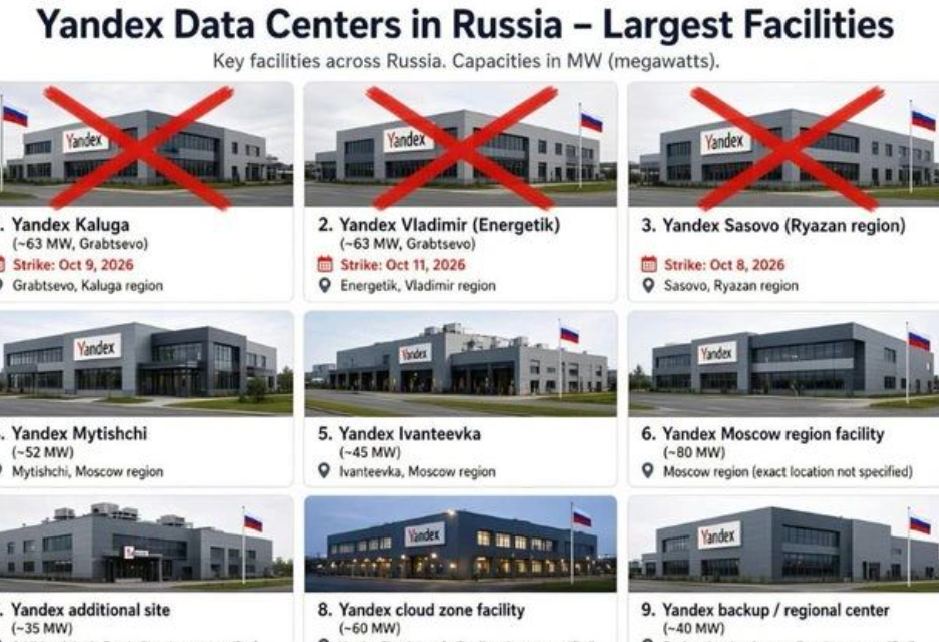
Ukraine strikes Russian Yandex data centres. Automated traffic collapses. Then observers begin reporting what looks like quieter political activity online, including around Germany’s AfD.
The conclusion practically writes itself:
Bomb the servers, silence the propaganda machine.
There is only one problem.
The evidence does not show that.
And the truth may actually be more unsettling.
Following reported Ukrainian strikes on several Yandex facilities between October 7 and 11, Cloudflare recorded spectacular declines across Yandex networks. Traffic from Yandex Search fell as much as 99% below baseline, while Yandex.Cloud dropped around 90%.
At first glance, that looked extraordinary.
But Cloudflare's deeper analysis found that almost all requests from the affected Yandex Search network were automated, with 93.6% of bot requests classified as verified bots. In other words, overwhelmingly legitimate automation such as search-engine crawlers, rather than evidence of political troll farms suddenly going dark.
That distinction destroys one viral narrative, but opens a much bigger question.
Because malicious automation was present elsewhere.
Cloudflare found malicious activity such as vulnerability scanning decline on Yandex.Cloud after the disruption. Yet the high-volume automation did not disappear. According to its analysis, it migrated to other hosting providers.
That may be the real story.
We like to imagine online influence infrastructure as a bunker: find it, destroy it, switch it off.
The internet doesn't necessarily work like that.
It behaves more like an ecosystem.
Remove one hosting provider and workloads can migrate. Block one piece of infrastructure and another can replace it. The physical server matters, but the network surrounding it matters more.
And what about Germany?
A claim that online activity supporting the Alternative für Deutschland (AfD) collapsed after the Yandex disruption spread widely, including with a graphic whose original source and methodology could not be established.
Subsequent analysis did not find the dramatic collapse the viral story suggested. One investigation examining Facebook activity connected with 76 AfD politicians found post-strike comments ranging from 8% below to 5% above expected levels. Researchers monitoring nearly 10,000 accounts across TikTok, Telegram and X also reportedly found no statistically significant decline.
So no, the evidence currently does not demonstrate that support for AfD disappeared when Russian servers went offline.
Nor does the evidence establish that American Republican or pro-Trump activity depends on Yandex infrastructure.
Those would be dramatic claims.
They require dramatic evidence.
But dismissing the entire episode would be equally mistaken.
Ukraine has exposed something strategically important: physical attacks on digital infrastructure can create measurable effects in cyberspace.
And some effects on suspected Russian inauthentic activity have been reported. A Ukrainian analysis cited in later reporting tracked 5,201 accounts displaying signs of inauthentic behaviour and found their message volume fell 83.6% after the October 8 disruption. Crucially, however, activity recovered above its previous level within 48 hours.
That is the fascinating part.
Not simply that the bots went down.
They came back.
Welcome to the newest battlefield, where servers are physical targets, influence operations are digital weapons and infrastructure can potentially migrate faster than an adversary can destroy it.
The old concept of strategic infrastructure meant bridges, railways, factories and power stations.
Now add data centres.
Ukraine's strikes did not prove that Russian servers secretly manufacture Western political support.
They demonstrated something subtler and perhaps more important:
The information war has infrastructure.
It lives somewhere. It consumes computing power. It depends on networks.
But increasingly, when one machine goes dark, another can take its place.
And that may be the most important warning of all.