The Politics of Peace: When Pacifism Meets the Battlefield
Few words possess the moral power of peace.
It is difficult to oppose.It sounds inherently virtuous.It appeals to a universal human desire to end suffering.
Yet history repeatedly demonstrates that the politics of peace are often more complicated than the word itself.
Recent demonstrations in the Netherlands calling for an end to what organizers describe as "war fever" have reignited a debate spreading across Europe: when a nation faces military aggression, does advocating peace automatically contribute to peace?
Or can it have the opposite effect?
The question is uncomfortable precisely because it challenges one of the most powerful assumptions in political discourse.
For much of modern European history, pacifism has been associated with humanitarian values, anti-militarism, and opposition to violence. These principles emerged from the catastrophic experiences of two world wars and became deeply embedded in European political culture.
The war in Ukraine has complicated that tradition.
Unlike many conflicts of recent decades, the war presents a relatively clear strategic reality: one sovereign state was invaded by another. The debate, therefore, is no longer focused solely on ending violence.
It is about determining the conditions under which violence ends.
This distinction matters.
A negotiated peace achieved after territorial conquest produces very different consequences than a peace achieved after successful defense against aggression.
The slogan "I choose peace" appears simple.
The policy implications behind it are not.
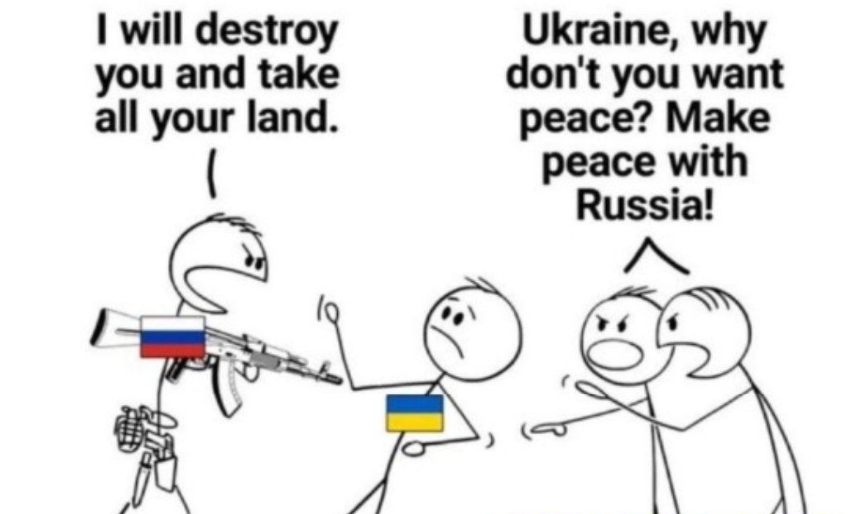
If peace is defined as the immediate cessation of military support for Ukraine, critics argue that the practical outcome may not necessarily be peace itself, but rather a shift in the balance of power on the battlefield.
This is why debates surrounding anti-war movements have become increasingly polarized throughout Europe.
Supporters describe themselves as voices for de-escalation, diplomacy, and conflict resolution.
Opponents see something different.
They argue that calls to reduce military assistance ignore the reality that defensive capabilities often determine whether a nation can negotiate from a position of strength or weakness.
The controversy becomes even sharper in the information domain.
Modern warfare is fought not only with artillery, drones, missiles, and soldiers.
It is also fought with narratives.
Strategic communication has become a central component of state competition.
Information campaigns seek to shape public opinion, influence political decisions, and affect the willingness of societies to sustain military, economic, or diplomatic commitments.
This reality creates a difficult challenge for democratic societies.
How can open political debate remain genuinely open while also recognizing that adversaries actively attempt to influence perceptions?
There are no easy answers.
Every democracy depends on pluralism and free speech.
At the same time, every democracy faces the challenge of distinguishing legitimate dissent from narratives that may align with the strategic interests of external actors.
This dilemma is not unique to the Netherlands.
Similar debates are taking place across Germany, France, Italy, the United Kingdom, and the United States.
The underlying question remains remarkably consistent:
At what point does opposition to military support become opposition to a country's ability to defend itself?
The answer often depends less on intentions than on outcomes.
Many activists sincerely oppose war in all forms.
Many supporters of military assistance sincerely believe that supporting Ukraine is the fastest route to a sustainable peace.
Both positions frequently claim the language of peace.
Yet they envision very different mechanisms for achieving it.
This reveals a broader paradox shaping European politics.
Everyone wants peace.
The disagreement concerns how peace is secured.
Can peace be preserved through deterrence?
Can peace be achieved through compromise?
Can peace survive without the ability to resist coercion?
These questions have become central to the European debate on security.
The war in Ukraine has forced societies to confront a reality that many hoped belonged to the twentieth century:
Peace is not merely the absence of war.
In some circumstances, peace depends on the capacity to prevent aggression from succeeding.
That is why discussions surrounding "peace protests" generate such intense reactions.
The debate is no longer about whether peace is desirable.
Nobody disputes that.
The debate is about whether peace is best protected through restraint alone or through a combination of diplomacy, deterrence, and defense.
And that may become one of the defining political questions of the coming decade.