The Ocean Is the New Battlefield: Quantum Systems Just Connected the Last Missing Domain
For years, defense technology companies competed to build better drones.
That era is ending.
The next defense race is not about individual platforms. It is about ecosystems.
And with the launch of Seavex and Subvex, German defense tech company Quantum Systems has sent a clear message to competitors, militaries, and investors alike:
The future is multi-domain, autonomous, and AI-driven.
From the skies above Ukraine to critical seabed infrastructure beneath the Baltic Sea, modern warfare is exposing a harsh reality. Threats no longer emerge from a single direction. They appear simultaneously in the air, on land, at sea, underwater, and increasingly in cyberspace.
Military organizations built around separate domains struggle to keep pace.
The real challenge is no longer collecting information.
It is connecting everything.
This is precisely what makes Quantum Systems' latest announcement more significant than another drone launch.
The company is not simply introducing two maritime platforms.
It is extending an existing digital ecosystem into the last major operational domain.
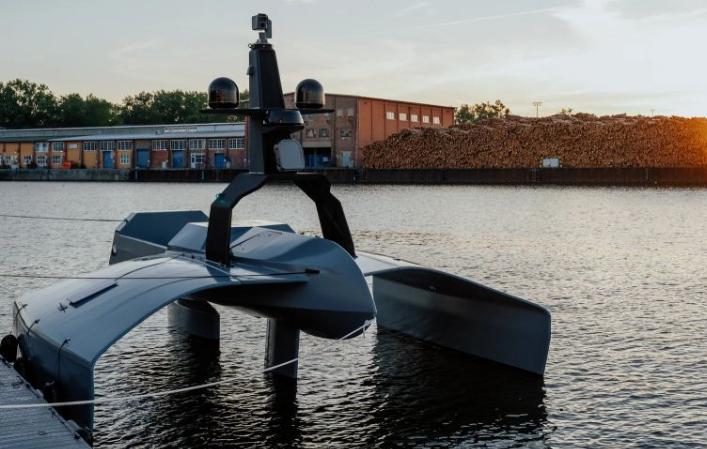
Seavex operates above the water.
Subvex operates below it.
Together, they complete a vision far larger than either vehicle alone.
For decades, defense procurement focused on platforms. Aircraft programs. Naval vessels. Ground vehicles. Each system was optimized individually and often operated inside its own technological silo.
The consequence was predictable.
Every new sensor produced more information. Every new platform increased complexity. Every new domain created another layer of fragmentation.
Military forces became rich in data but poor in integration.
The result is a paradox of modern warfare.
Commanders often have more information available than at any point in history, yet struggle to transform it into clear operational understanding quickly enough.
This is where software becomes decisive.
Quantum Systems' MOSAIC UXS architecture aims to turn disconnected autonomous systems into a common operational network. A drone in the sky, a surveillance vessel on the surface, and an underwater vehicle thousands of meters below can theoretically contribute to the same operational picture.
The platform becomes the product.
The vehicles become nodes.
That distinction changes everything.
Seavex alone demonstrates how dramatically autonomous maritime operations are evolving. With extended deployments measured in months rather than days, integrated radar systems, onboard AI processing, and the ability to launch and recover other unmanned assets, the vessel operates less like a traditional sensor platform and more like a mobile data hub.
Meanwhile, Subvex pushes surveillance into one of the least visible military environments on Earth.
The deep ocean.
Capable of operating at extreme depths and remaining underwater for extended periods, autonomous underwater systems represent a rapidly growing strategic capability. Recent incidents involving submarine cables, pipelines, and other critical infrastructure have elevated underwater awareness from a niche military concern to a national security priority.
The ocean floor is becoming strategic terrain.
And unlike the skies, it remains largely invisible.
This explains why maritime autonomy is attracting unprecedented attention across NATO.
Countries face an uncomfortable reality.
The infrastructure supporting modern economies stretches across vast maritime regions. Energy pipelines, fiber-optic cables, offshore platforms, shipping corridors, and naval routes create an enormous area that is simply too large for continuous human monitoring.
Autonomous systems change the equation.
Not by replacing humans.
But by extending their reach.
The significance of Quantum Systems' move, however, goes beyond maritime security.
It signals a broader transformation occurring throughout the defense industry.
The winners of the next decade may not be the companies that build the fastest drone, the deepest-diving vehicle, or the longest-range sensor.
They may be the companies that connect them all.
Investors have already discovered this pattern in commercial technology.
The most valuable companies are often not hardware manufacturers.
They are platform operators.
Defense appears to be following the same path.
As autonomous systems proliferate, the competitive advantage shifts from individual machines toward the software layers that coordinate, synchronize, and scale them.
The battlefield is becoming a network.
And networks reward integration.
That is why Seavex and Subvex matter.
Not because they add two more autonomous vehicles to a growing market.
But because they represent another step toward a future where air, land, surface, underwater, and digital operations become part of a single intelligent ecosystem.
The age of standalone military platforms is fading.
The age of connected autonomy has arrived.
And increasingly, victory may belong not to the force with the most systems but to the one whose systems think together.