The Most Important Part of a Medical Evacuation Train May Not Be the Train
When people imagine a military medical evacuation train, they picture the obvious things: carriages, hospital equipment, doctors and rows of patients moving away from a crisis zone.
But the most consequential innovation may be much smaller.
The patient interface.
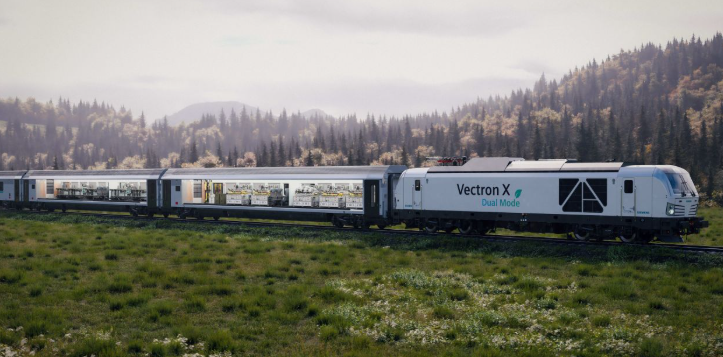
Siemens Mobility and Lufthansa Technik Defense have announced a memorandum of understanding to develop a medical evacuation train concept for Germany's armed forces and other NATO allies.
The proposed system is substantial. Its design envisages capacity for more than 150 patients and as many as 90 medical and support personnel, combining Vectouro coaches and Vectron locomotives with medical technology derived from Lufthansa Technik's aeromedical experience.
Those numbers will inevitably attract attention.
But capacity may not be the most interesting part of the concept.
The potentially transformative idea is what happens when the train stops.
The dangerous gap between two vehicles
In military medicine, evacuation is not simply about transportation. It is about maintaining a chain of care while patients move through multiple environments.
A casualty might travel by ground vehicle, rail and aircraft during the same evacuation chain. Every transition introduces complexity.
Beds may change. Monitoring equipment may need to be reconfigured. Medical teams hand over responsibility. Critically ill patients may have to be physically moved when they are least suited to being moved.
That makes the interface between transportation systems almost as important as the vehicles themselves.
The concept presented by Siemens Mobility and Lufthansa Technik Defense addresses precisely that problem through standardised Patient Transport Units, intended to operate across different modes of transportation.
The proposed logic is compelling: instead of transferring the patient from one medical bed to another when changing from aircraft to rail, move the patient together with the transport unit.
The aircraft and train effectively speak the same medical language.
From hospital train to medical network
That changes how we should think about a modern evacuation train.
It is not simply a hospital installed on rails.
Potentially, it becomes one component of a wider medical-logistics architecture connecting different evacuation stages.
This matters especially in Europe.
Railways can move large numbers of people across continental distances without putting the same demand on aviation assets. In a major crisis, that could make rail an important complement to road and air evacuation rather than an antiquated alternative to them.
But interoperability is the hard part.
A train capable of carrying 150 patients is impressive. A system capable of moving casualties smoothly between different transportation modes without repeatedly breaking the chain of care could be considerably more valuable.
Concept is not capability
There is, however, an important line between ambition and operational reality.
The announcement concerns development cooperation under a memorandum of understanding. It should not be confused with a procurement contract, a delivered train or proof of clinical performance.
Likewise, an overall capacity exceeding 150 patients does not mean that 150 intensive-care places would be available.
That distinction is critical.
For military medical planners, the real performance questions come next: How many patients at each level of care can actually be supported? How are power, oxygen, monitoring and ventilation maintained? How quickly can patients be loaded and unloaded? What happens during an aircraft-to-rail handover? And which parts of that process have been tested and qualified as one complete system?
Those answers will ultimately determine whether this becomes an interesting train or a genuinely important NATO medical capability.
Because in mass-casualty evacuation, success cannot be measured simply by the number of beds that fit inside a carriage.
The real measure is whether the patient can move across an entire continent while the medical system around them never breaks.