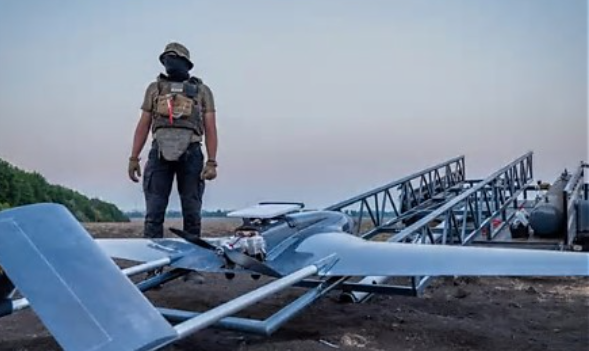
The Invisible Shield: How Ukraine Is Fighting Missiles With Ghost Signals Instead of Missiles
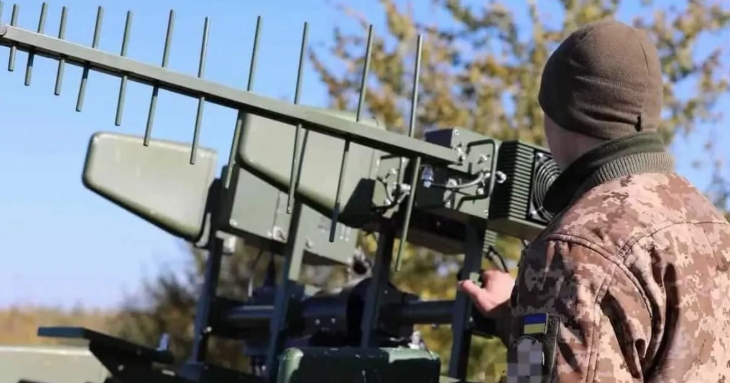
The most powerful weapon on tomorrow's battlefield may not explode.
It may not even be visible.
According to reports from the war in Ukraine, some of the fiercest battles are no longer being fought with missiles, tanks, or artillery. They are being fought with mathematics, radio waves, algorithms, and deception.
In one remarkable episode reported by The Wall Street Journal, two Russian ballistic missiles reportedly headed toward Kyiv's government district were diverted by Ukrainian electronic warfare systems and ultimately fell into the Dnipro River instead of striking their intended targets.
There were no dramatic interceptor launches.
No air-defense missiles streaking across the sky.
Just invisible signals rewriting the missiles' understanding of reality.
At the same moment, Kyiv residents reportedly noticed something bizarre. Their phones suddenly appeared to be located thousands of kilometers away in Peru.
That was not a software glitch.
It was allegedly the effect of Ukraine's Lima electronic warfare system, which flooded the environment with deceptive navigation signals, creating a false digital landscape.
Humans were confused.
The missiles were fooled.
Welcome to the age of electronic warfare.
For decades, military power was measured by how much firepower a nation could deliver.
Today, the question is increasingly different:
Can you convince an enemy weapon that reality is something else?
That challenge sits at the center of a rapidly escalating technological arms race.
Missiles, drones, guided bombs, reconnaissance systems, and autonomous platforms all depend on information. They require positioning data, communications signals, navigation references, and sensors.
Remove those inputs and the weapon becomes blind.
Corrupt them and the weapon can become lost.
Exploit them and the weapon may destroy nothing at all.
Perhaps the most provocative claim involves Russia's Kinzhal hypersonic missile, a weapon long presented as nearly impossible to intercept.
According to Night Watch, a Ukrainian electronic warfare unit, a Lima system transmitted deceptive navigation data that caused a Kinzhal missile to alter its trajectory until the stress of high-speed flight reportedly caused it to break apart.
Whether future independent verification supports every operational detail or not, the broader reality remains undeniable:
Electronic warfare has become one of the most decisive components of the modern battlefield.
This is no longer simply a contest between offense and defense.
It is a contest between software engineers.
The adaptation cycle resembles Silicon Valley more than traditional military procurement.
When one side discovers an electronic vulnerability, the other side develops a countermeasure.
When frequencies are jammed, new frequencies emerge.
When navigation systems are spoofed, new antennas appear.
The cycle repeats endlessly.
According to Ukrainian specialists, Russian missiles and drones have evolved rapidly. Systems reportedly incorporating Chinese-made antenna arrays can identify sources of interference and help weapons resist jamming.
First came four antennas.
Then eight.
Then sixteen.
Now dozens.
Every innovation forces a response.
Every response triggers another innovation.
The result is a technological duel unfolding at extraordinary speed.
What once took years of military development now happens in months.
Sometimes weeks.
Night Watch and the developers behind Lima reportedly created the upgraded Lima Quant system in just three months, designing algorithms intended to overcome increasingly sophisticated missile and drone defenses.
This is modern warfare's hidden front line.
Not trenches.
Not armor.
Not aircraft.
Code.
The importance of this invisible battlefield becomes most obvious when viewed through individual stories.
One Ukrainian fighter described a Russian drone flying directly toward his position.
Moments later, electronic interference disrupted the drone's controls and sent it crashing.
No missile was fired.
No gunshot was heard.
Yet a life was saved.
For the soldier involved, electronic warfare wasn't a strategic concept.
It was survival.
That may be the ultimate lesson emerging from Ukraine.
The future battlefield will still have tanks.
It will still have missiles.
It will still have artillery.
But increasingly, victory may belong to whoever controls the electromagnetic spectrum.
The side that sees first.
The side that deceives best.
The side that can convince enemy machines that up is down, left is right, and Kyiv is somehow located in Peru.
Because in the wars of the future, the deadliest weapon may not be the missile.
It may be the signal that tells the missile where to go.