The Helicopter Is Becoming a Drone Carrier: Ukraine’s Next Aviation Revolution

For more than a century, military aviation has been defined by the aircraft itself.
Speed. Altitude. Maneuverability. Radar. Weapons. Survivability.
But Ukraine may be pointing toward a very different future, one in which the most important question is no longer what can this aircraft do?
It is: What can this aircraft launch?
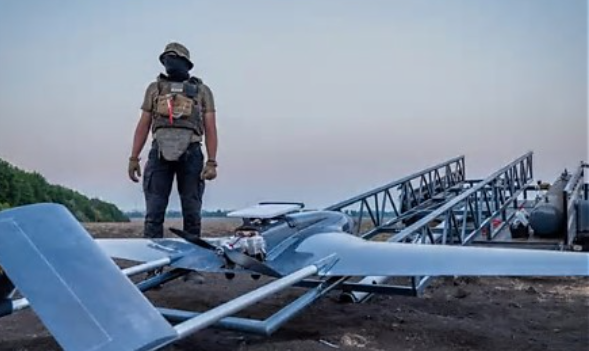
According to the reported concept described in your source text, Ukrainian Land Forces helicopters are carrying propeller-driven interceptor drones known as Litavr. Their purpose is strikingly simple: instead of forcing the helicopter itself to chase an aerial target, the aircraft can launch another flying machine to do the intercepting.
Think of it as an air-to-air weapon with a propeller.
That sounds almost primitive compared with the extraordinary engineering of a modern missile. Yet the underlying idea could be significant.
Traditional air combat places enormous capability inside the launch platform. Advanced sensors, weapons, pilots, engines and defensive systems are integrated into an aircraft costing millions, and sometimes tens of millions, of dollars.
The drone revolution begins to separate those capabilities.
The helicopter becomes the carrier.
The interceptor drone becomes the hunter.
And the crew increasingly becomes the manager of a distributed system rather than the sole operator of a single fighting machine.
That distinction matters because the same logic has already transformed warfare on the ground. Drones have separated reconnaissance from the scout, precision attack from the artillery piece and increasingly sensing from the platform carrying the sensor.
Now that logic is moving into the air.
A helicopter carrying interceptor drones does not need to behave exactly like a conventional fighter. It can potentially serve as a mobile launch point that brings smaller aerial systems closer to the area in which they are needed.
The larger conceptual shift is even more interesting.
For decades, militaries pursued increasingly capable aircraft. More sophisticated radar. Better missiles. Greater range. More powerful electronic warfare. More expensive integration.
Drone warfare introduces another possibility: move capability away from the aircraft and distribute it among the machines the aircraft carries.
The aircraft then stops being only a weapons platform.
It becomes a platform for platforms.
That could eventually reshape how we think about everything from helicopters and transport aircraft to fighters.
Imagine the evolutionary path.
First, aircraft carried bombs.
Then missiles.
Then increasingly sophisticated stand-off weapons.
Now they can carry intelligent, maneuvering aerial vehicles capable of searching for and pursuing other airborne machines.
The distinction between a missile and a drone also begins to blur. One is conventionally fired at a target and expended. The other can potentially maneuver, search and receive guidance during its mission. From the perspective of the launching aircraft, however, both perform a similar strategic trick:
They push the fight away from the aircraft.
And that may be the real revolution.
The future of military aviation may not belong exclusively to the aircraft with the greatest speed, payload or maneuverability. It may belong to the aircraft capable of orchestrating the largest, cheapest and smartest network of machines around it.
Ukraine’s war has accelerated experimentation with drones at extraordinary speed. What started predominantly with small reconnaissance aircraft expanded into FPV strike drones, long-range systems and increasingly specialized designs.
Airborne interception represents another step in that evolution.
The helicopter is no longer necessarily the hunter.
It can become the mothership.
And once aircraft start launching aircraft to fight other aircraft, the boundaries between fighter, missile, drone and carrier begin to disappear.
That is when aviation gets really interesting.