The Drone That Hasn’t Struck: What Is al-Shabaab Waiting For?
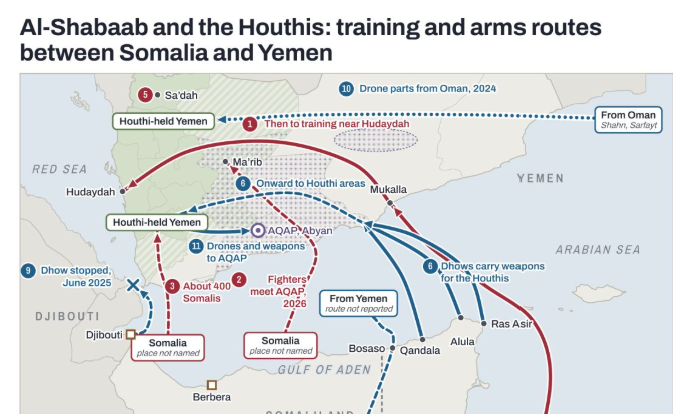
The Houthis have trained al-Shabaab fighters in drone warfare. Technical knowledge is moving across the Gulf of Aden. Yet Somalia is still waiting for the attack many analysts expected. That silence may be the most interesting part of the story.
The most revealing drone in Somalia may be the one that has not yet exploded.
For years, al-Shabaab has demonstrated considerable capacity for adaptation. The organization has employed drones primarily for surveillance and propaganda, while becoming one of al-Qaeda’s most resilient affiliates. Yet despite mounting evidence of contacts with Yemen’s Houthis, training in drone operations and growing exchanges of military knowledge, Somalia has not seen the armed-drone campaign that many feared would follow. ISS Africa reported that the group had mainly used drones for intelligence, surveillance and propaganda, while UN reporting described its relationship with the Houthis as transactional or opportunistic.
That absence deserves attention.
The relationship across the Gulf of Aden has become increasingly difficult to dismiss as coincidence. Recent reporting says groups of al-Shabaab fighters have travelled to Yemen for instruction in drones, explosives and weapons, while Houthi specialists have reportedly travelled in the opposite direction. A 2026 account citing a UN panel described four groups of roughly 30 fighters travelling to Yemen during the previous year.
The relationship is surprising because ideology should make the two movements uncomfortable partners. But war has a habit of making logistics more persuasive than theology.
Al-Qaeda in the Arabian Peninsula, once an active battlefield enemy of the Houthis, has itself moved toward what UN reporting described as a pragmatic, opportunistic arrangement involving non-aggression, prisoner exchanges and weapons movements.
That matters because Yemen can become more than a neighboring conflict.
It can become a technology bridge.
The Houthis have spent years developing drones, missiles and the supply networks needed to sustain them. Their campaign against Red Sea shipping demonstrated that relatively inexpensive unmanned systems can impose costs far beyond the price of the weapon itself. The Combating Terrorism Center at West Point documented how the Houthi priority on UAV and missile programs has accompanied deeper connections with AQAP, al-Shabaab and Horn of Africa smuggling networks.
So why hasn't al-Shabaab crossed the line?
The tempting answer is that it simply cannot.
That may be true. Training is not the same as possessing a reliable strike capability. Technical knowledge does not automatically create supply chains, manufacturing capacity, trained operators and sufficient inventories.
But there is another possibility.
Capability does not have to be demonstrated the moment it is acquired.
The most detailed recent reporting explicitly raises this uncertainty: the absence of Houthi-made drones on Somali battlefields could reflect limited trust, inadequate absorptive capacity, or a deliberate al-Shabaab decision to conceal capabilities until there is a compelling reason to expose them.
That distinction changes the intelligence question.
Instead of asking“Does al-Shabaab have attack drones?” analysts may need to ask:
“What battlefield conditions would make revealing such a capability worthwhile?”
Because once a new weapon appears, surprise begins to decay. Defenders study it. Countermeasures emerge. Bases change procedures. Electronic warfare adapts.
The first strike therefore does more than destroy a target.
It reveals a capability.
And that makes restraint potentially valuable.
The bigger story consequently stretches beyond Somalia. What is emerging across the Gulf of Aden is an ecosystem in which organizations with profound ideological differences can nevertheless exchange training, logistics and technical knowledge when their interests converge. The Africa Center for Strategic Studies assesses that growing al-Shabaab-Houthi cooperation is increasing security risks on both sides of the Bab al-Mandab.
The danger is therefore not simply that an armed al-Shabaab drone eventually appears over Somalia.
It is that the infrastructure for learning how to build, modify and employ increasingly sophisticated systems may be spreading across networks faster than individual weapons can be tracked.
And when the first strike finally comes, the most important question may not be where the drone came from.
It may be:
How long had the capability existed before somebody decided to reveal it?