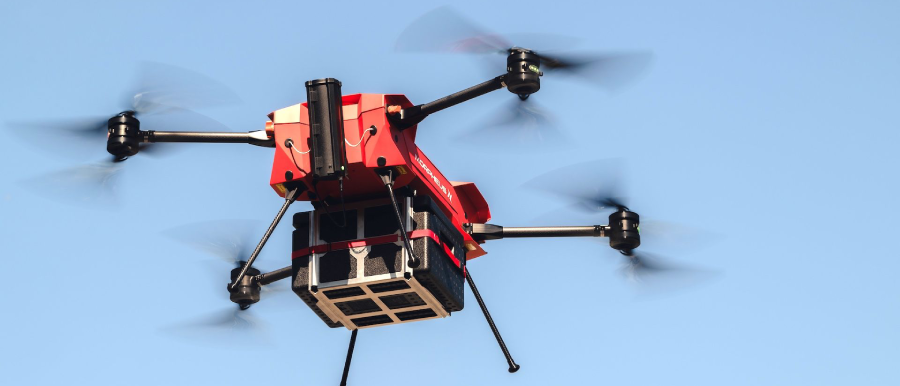
The Drone Killer That Refuses to Choose: How Britain’s TRV-150 Became a Flying Arsenal Against the UAV Swarm

For years, military planners have faced a painful dilemma.
Use expensive missiles to destroy cheap drones and risk losing the economic battle, or accept that increasingly sophisticated unmanned aircraft will continue to threaten troops, ships, and critical infrastructure.
A recent test over Florida may have just offered a compelling third option.
In late September, a modified version of Britain's TRV-150 unmanned air system demonstrated its ability to intercept multiple one-way attack drones in a single mission while carrying laser-guided rockets and remaining airborne throughout the engagement. The trials, conducted during a U.S. military experimentation exercise at Eglin Air Force Base, mark another significant step in the race to create affordable and scalable counter-drone capabilities.
The significance extends far beyond a successful weapons test.
The modern battlefield is experiencing an unprecedented drone explosion. Conflicts from Eastern Europe to the Middle East have shown that relatively inexpensive unmanned systems can overwhelm traditional air defenses, gather intelligence, and deliver devastating attacks. Military forces are increasingly searching for solutions that are not only effective but economically sustainable.
That is where the TRV-150 enters the conversation.
Originally developed as a logistics drone, the aircraft already established an operational reputation delivering supplies for the Royal Navy and Royal Marines. Instead of designing an entirely new combat platform, engineers chose a more disruptive path: transforming an existing workhorse into a multi-role battlefield asset capable of both supporting troops and defending them.
The result is remarkable.
During the latest U.S. trials, the TRV-150 was equipped with a production-ready three-pod launcher firing BAE Systems' laser-guided Advanced Precision Kill Weapon System, better known as APKWS. Unlike previous demonstrations that focused on a single engagement, this event proved the aircraft could attack multiple airborne targets during the same sortie without landing or reloading.
That capability addresses one of the most pressing realities of modern warfare.
Drone attacks increasingly arrive in groups rather than individually. Swarm tactics seek to saturate defenses, forcing operators to expend costly interceptors faster than attackers can launch new threats. A platform capable of engaging multiple targets with relatively low-cost precision weapons offers a potentially game-changing equation.
But perhaps the most interesting aspect is not the missile.
It is the platform.
Traditional military procurement often produces highly specialized systems designed for a single mission. The TRV-150 challenges that model. One day it can transport ammunition, medical supplies, or spare parts. The next, it can be configured as an aerial interceptor. Future variants may operate from ships, extending protection to naval forces facing increasingly sophisticated drone threats.
This flexibility is becoming a defining characteristic of next-generation military technology.
Modern armed forces no longer simply want platforms. They want adaptable ecosystems capable of evolving faster than threats emerge. As drone technology advances at breathtaking speed, systems that can be modified, upgraded, and repurposed gain a strategic advantage over rigid designs.
The companies behind the achievement understand that urgency.
BAE Systems, Malloy Aeronautics, and SURVICE Engineering have moved rapidly from initial concept demonstrations to increasingly mature operational capabilities. What began as a single-shot experiment has evolved into a multi-target, mission-ready system designed around real-world battlefield requirements.
This pace matters.
Military leaders frequently emphasize that technology development cycles must accelerate if democracies are to keep pace with emerging threats. In many cases, the speed of delivery now carries as much strategic importance as technical performance. A highly capable system delivered too late may provide little value against adversaries who innovate continuously.
The TRV-150 story illustrates a broader transformation occurring across global defense markets.
The future is no longer about drones versus traditional weapons.
It is about drones carrying weapons.
It is about logistics platforms becoming combat systems.
It is about inexpensive autonomous aircraft taking on missions once reserved for sophisticated fighter jets and billion-dollar defense programs.
Most importantly, it is about redefining what military aviation looks like in the age of autonomous warfare.
The battlefield of tomorrow may not be dominated by the largest aircraft, the fastest missiles, or the most expensive defense systems.
It may belong to the platforms that can do everything.
And Britain's TRV-150 is making a compelling case that it intends to be one of them.