The Drone Is No Longer the Weapon. The Network Is: Inside Estonia’s Multi-Domain Robotics Experiment

A flying drone is useful. A ground robot is useful. An unmanned boat is useful.
But the more interesting question is what happens when they stop behaving like isolated machines and start operating as parts of a larger system.
That was the idea behind a live multi-domain unmanned-systems demonstration organized by Ondas Capital at Port of Tallinn’s Muuga Harbour on September 23, during Estonian Defence Week 2026. Unmanned Defense Systems, Ark Robotics, DK NEJET and SPARK Boats took part.
The focus was not simply another parade of interesting drones.
According to Ondas Capital, the purpose was to demonstrate how unmanned platforms can operate together in modern warfare, complementing one another instead of functioning alone, with autonomy seen as the direction in which the sector is moving.
That distinction matters.
Stop thinking about drones. Start thinking about systems.
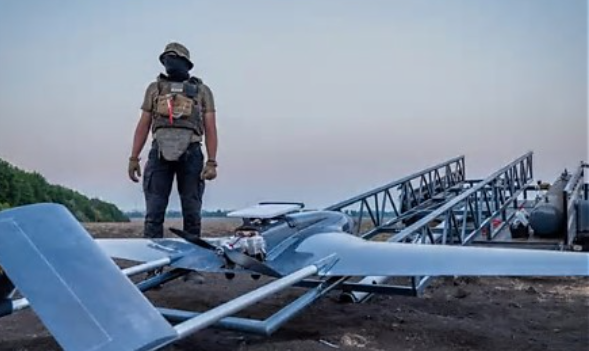
The demonstration brought different unmanned domains into one setting: UAVs in the air, UGVs on land and USVs on the water. Ondas Capital described the event as featuring UAV, UGV and USV technologies, although weather prevented some systems from flying.
James Acuna, COO and Managing Director of Ondas Capital, made the investment thesis unusually clear. He said the company is in Europe to invest across unmanned-systems technologies, including supply chains, flying and floating drones, UGVs, simulators and AI.
And Ondas Capital is not presenting itself as a small experimental fund. Its LinkedIn profile describes it as a $150 million, multi-year investment and advisory platform established by Ondas Inc. in September 2025 to accelerate battlefield-tested unmanned technologies from Ukraine into European and American markets.
Ukraine is consequently central to this story.
The event organizers said the technologies presented came from young independent engineering teams and startups across the Baltics and Ukraine, with systems that have already been tested and used in Ukraine.
Some participants illustrate that battlefield-to-industry pipeline.
Ark Robotics says its technology is deployed across more than 20 units of the Armed Forces of Ukraine and is being improved through operational feedback as the company scales in the European Union.
Unmanned Defense Systems, headquartered in Vilnius, describes an interoperable mission ecosystem combining FORECASTER intelligence, surveillance, target acquisition and reconnaissance platforms, AVENGER strike UAVs, HAULER multi-payload UAVs and its SwarmC2 command-and-control software.
DK NEJET, meanwhile, says it develops FPV platforms, interceptors and strike drones alongside software intended to keep autonomous systems functioning when communications are degraded or GPS becomes unreliable.
Put those pieces together and an important industry shift begins to appear.
The next competition is about orchestration
For years, defense-tech headlines have been dominated by individual machines: the fastest interceptor, the longest-range strike drone, the cheapest FPV or the most capable unmanned boat.
The Muuga demonstration points toward another question:
Who can make different machines work together?
That is partly analysis rather than a claim that the September event proved a fully integrated battlefield architecture. The available event material says its goal was to demonstrate complementary multi-domain unmanned capabilities. It does not provide independently verified performance results for a complete autonomous swarm or combat network.
But the direction is significant.
The military value of the next generation of unmanned technology may increasingly come from the connections between machines: sensing, command and control, autonomy, data exchange and the ability to combine air, land and maritime platforms for a mission.
That makes Estonia an interesting place for this conversation.
The hardware at Muuga was important.
The bigger story was the attempt to show that the future battlefield may not be dominated by one extraordinary drone, but by many specialized machines learning to operate as one system.
And if that proves correct, the next defense-tech race will not simply be about who builds the best robot.
It will be about who builds the network that makes all the robots useful together.