The Decoy That Learned to Fight: Russia’s “Gerbera” Drone Is Becoming Something More Dangerous
It was supposed to be the cheap drone.
A disposable decoy sent into contested airspace to confuse defenders, trigger radars and force expensive air-defence systems to waste interceptors.
But the latest reported evolution of the Russian Gerbera suggests something far more consequential: the decoy is becoming a weapon in its own right.
Early Gerbera variants reportedly appeared in reconnaissance and kamikaze configurations but remained relatively simple and inexpensive aircraft. Over time, their onboard equipment has grown more sophisticated, incorporating improved navigation, communications and imaging technology.
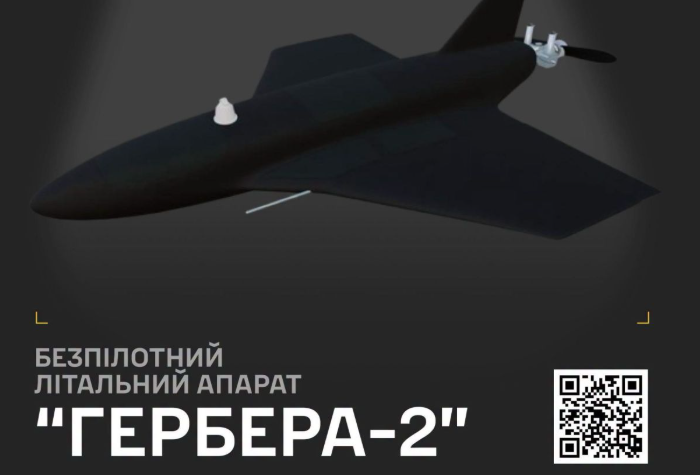
Now an enlarged version, described as Gerbera-2, appears to push that evolution considerably further.
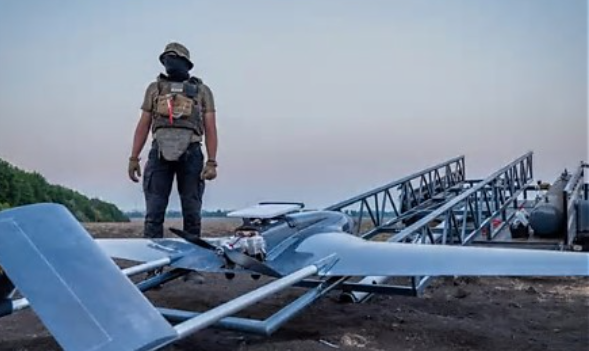
According to the technical description supplied, the new aircraft has a three-metre wingspan and a fuselage 2.6 metres long. A 63-litre fuel tank reportedly gives it a potential range of up to 1,200 kilometres.
If those figures prove representative of operational aircraft, Gerbera is no longer interesting simply because it can saturate Ukrainian air defences. Its potential geographical reach becomes part of the security equation.
More range, more payload, more roles
The examined aircraft reportedly carried a 10-kilogram high-explosive fragmentation incendiary warhead, together with additional incendiary material. The stated maximum payload is said to reach 25 kilograms.
That still places it in a different class from much larger strike systems.
But focusing exclusively on warhead size misses the point.
The disturbing characteristic of the Gerbera concept is its potential flexibility.
The same broad family can potentially create uncertainty for defenders: Is the approaching aircraft a decoy? A reconnaissance platform? An armed strike drone?
Every additional role makes that identification problem harder.
And every second spent identifying the threat matters.
The electronics are becoming as important as the airframe
The reported evolution is particularly visible inside.
The examined configuration was described as carrying an updated flight controller, a 12-channel Kometa module, a mesh modem made by China’s Shenzhen Sinosun Technology, and a video-processing unit reportedly based on a Chinese microcomputer.
A dual IP camera was positioned above the fuel tank, apparently for detecting interceptors. Other recovered configurations have reportedly included forward-looking cameras and cameras installed on three-axis gimbals.
The implication is striking: this is not merely about flying farther with a bigger fuel tank.
It points toward a platform becoming increasingly aware, connected and adaptable.
The supplied component analysis also illustrates another uncomfortable reality of contemporary drone warfare. Eight identified components were attributed to Chinese manufacturers and four to American manufacturers.
Modern weapons do not necessarily require an entirely bespoke military supply chain. Commercial electronics can find their way into military systems, creating an increasingly difficult challenge for export controls and component traceability.
From Ukraine to NATO’s doorstep?
Perhaps the most politically significant element is the reported geographical expansion.
According to the supplied account, an armed Gerbera-2 was found on Poland’s Baltic coast in mid-September.
The circumstances and intended mission of that specific aircraft would need to be established independently before broader conclusions could be drawn. But combined with the claimed 1,200-kilometre range, the incident raises a much larger question.
What happens when a drone originally designed to exhaust air defences acquires enough range, sensing technology and payload capacity to become a more versatile threat itself?
That question matters far beyond one drone model.
The Gerbera’s reported evolution illustrates the extraordinary speed at which unmanned warfare is changing. Cheap airframes can receive better navigation. Commercial cameras can improve observation. Networking can increase connectivity. Larger tanks extend reach. Different payloads transform mission sets.
And improvements do not have to produce an exquisite weapon.
They only need to create a platform dangerous enough that defenders cannot afford to ignore it.
That may ultimately be the Gerbera’s most disruptive feature.
Yesterday’s decoy forced air defence to decide whether to shoot. Tomorrow’s version may ensure there is no choice.