On War 21st Century Part III. The Return of Maneuver / by Diego Bavio
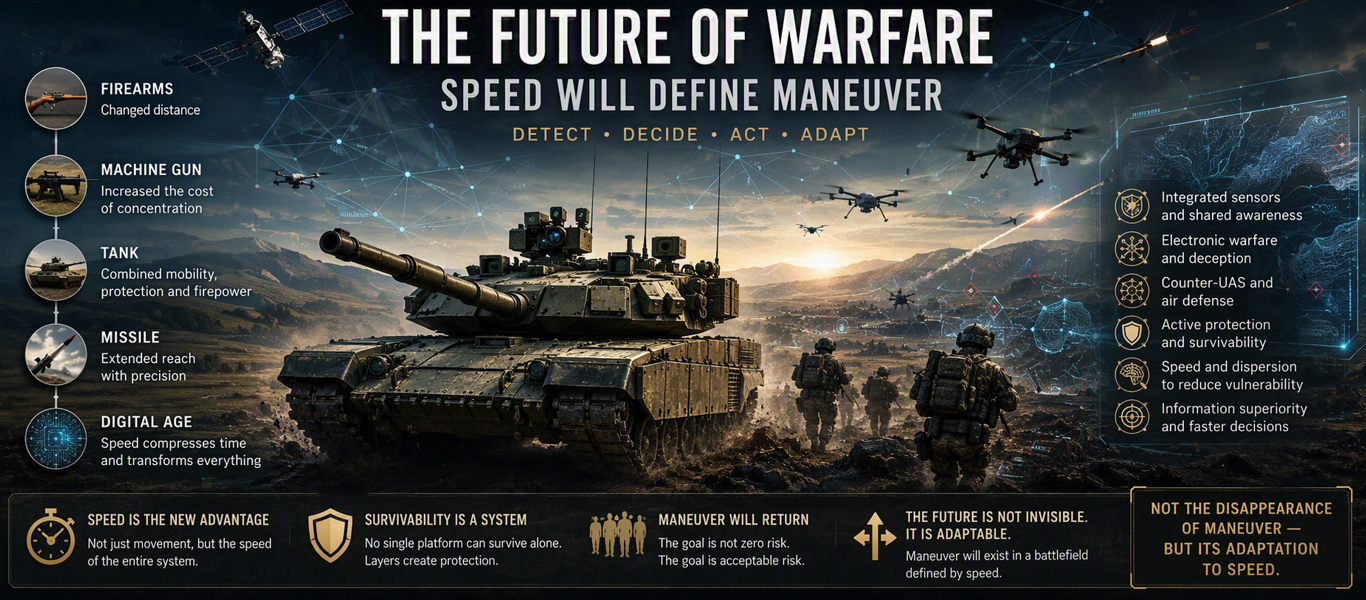
The history of warfare can be read as a succession of changes in the balance between fire, movement, protection, and time. The emergence of firearms profoundly altered the relationship between the combatant and distance. The machine gun transformed the ability to generate fire and dramatically increased the cost of any exposed concentration of forces. The tank introduced an unprecedented combination of mobility, protection, and firepower, while the missile made it possible to project destructive effects over increasingly greater distances and with a degree of precision that once again transformed the relationship between the shooter and the target.
Today, we are going through another paradigm shift. The difference is that this transformation is not being driven by a single platform or weapons system. It is digital. Its most important characteristic is not simply the ability to see farther, shoot farther, or automate certain functions. It is speed: speed to detect, transmit, process, decide, and strike — but above all, speed to learn and act again.
Digital warfare is compressing the time between perception and effect, and that compression is once again changing the relationship between fire and movement.
The Mirage of a War Without Maneuver
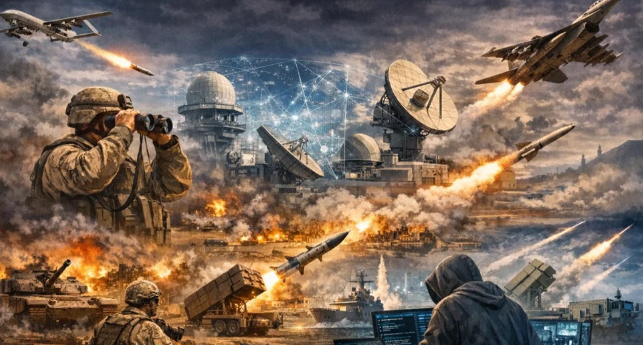
The war in Ukraine offers the clearest empirical demonstration of this transformation. Commercial drones adapted for military purposes, unmanned aircraft specifically designed for combat, distributed sensors, satellite imagery, digital communications, and artificial intelligence systems have created levels of battlefield observation that would have been difficult to imagine only a few decades ago.
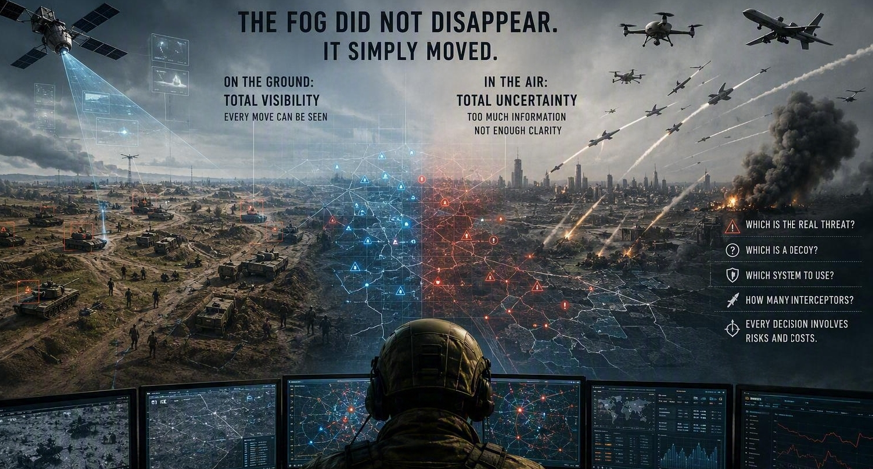
The initial result appears paradoxical. The better the battlefield can be observed, the harder it seems to become to maneuver. A concentration of vehicles can be detected. An artillery position can be located after opening fire. A movement that for decades might have remained concealed can rapidly become information available to the adversary.
Technology did not eliminate movement; it reduced the ability to hide it. And that distinction is fundamental. If concentration becomes too vulnerable, the rational response is dispersion. If remaining visible means being attacked, forces seek to reduce their signatures, divide themselves, conceal their movements, and limit their exposure time.
The result can be a static front, with small territorial gains and enormous amounts of technology being employed to produce relatively small movements. This could lead us to imagine a kind of “All Quiet on the Western Front 2.0”: a highly digitized trench war in which sensors replace observers, drones replace reconnaissance patrols, and algorithms process information that once arrived through other means.
But turning that snapshot into a prediction about the future of warfare would be a mistake. The trench war was not the destiny of industrial warfare. It was the consequence of a particular technological imbalance at a particular moment. But that imbalance did not merely change weapons. It affected something deeper within the military establishment: doctrine.
The same may be happening today.
The Problem Is Not Risk
There is another premise that deserves to be challenged. Much of the contemporary debate about the future of armored warfare appears to contain an implicit assumption of zero risk: if a vehicle can be detected and destroyed by a drone, missile, or anti-tank weapon, then employing it must no longer be rational.
But zero risk never existed in warfare. Soldiers could die. Ships could sink. Aircraft could be shot down. Tanks could be destroyed by other tanks, artillery, mines, or anti-tank weapons. The military question was never how to eliminate risk completely. It was how to make the risk assumed acceptable in relation to the military effect expected in return.
That distinction is fundamental. The question is not whether a platform can be destroyed. The question is whether a force can employ it and survive long enough to produce the required military effect.
This is where digital warfare is creating its most important challenge. For a period of technological evolution, the ability to observe and attack appears to have evolved faster than the ability to protect and move forces. The result has been an imbalance in the risk equation: concentration became too dangerous, maneuver became too costly, and the defense gained a considerable advantage.
But technological imbalances are rarely permanent.
MLV and the Reconstruction of Survivability
The answer is beginning to emerge at multiple levels.
MLV should not be understood simply as a way of making armored vehicles more resistant to drones. It is, in a broader sense, the process through which platforms and units acquire new capabilities that allow them to operate again within an increasingly observed and increasingly fast battlefield.
For a tank, this may mean active protection systems capable of detecting and intercepting certain threats before they reach the platform. The evolution of systems such as Arena illustrates precisely this direction: increasing the organic ability of the unit itself to detect and respond to threats that previously depended more heavily on external layers of protection.
But that is only one layer. An armored formation can also incorporate electronic warfare, sensors, counter-UAS systems, and short-range air defense. Systems such as the Gepard or Shilka therefore acquire a relevance that goes beyond the individual platform. Integrated into a formation, they can contribute to creating a new protective architecture around the units that need to move.
The objective is not to build an invulnerable armored vehicle. It is to build a formation that can survive.
This distinction may prove decisive. Survivability ceases to be an exclusive property of a platform and becomes a property of the system. Tanks, infantry, sensors, electronic warfare, air defense, drones, fires, and command-and-control systems can form different layers of the same architecture. Each reduces part of the risk. None eliminates the threat completely. But the cumulative result may bring risk back within an operationally acceptable level.
Two Speeds of Adaptation
There is another reason why technological evolution does not advance at the same speed across all platforms.
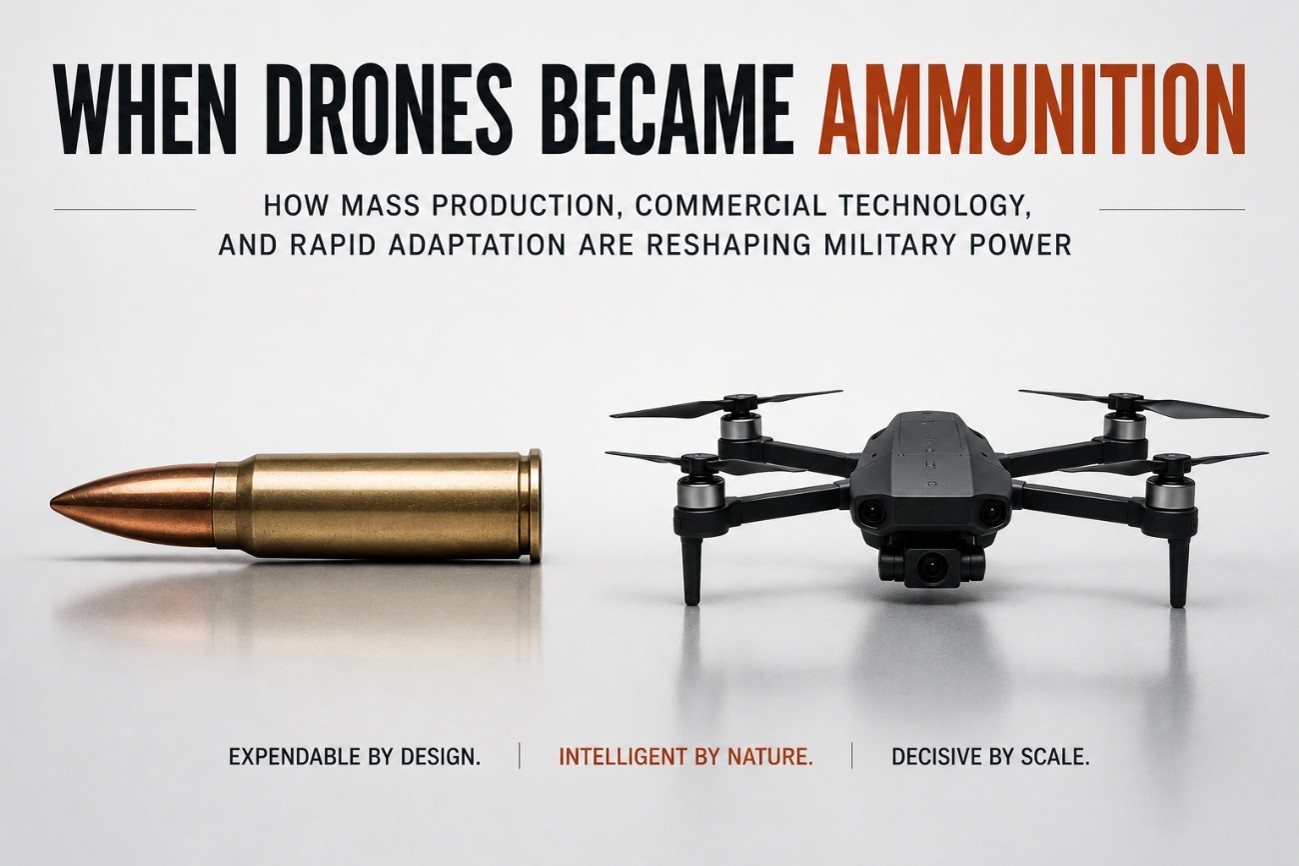
Drones had a particular advantage: to a large extent, they created their own development niche. They did not have to start from a manned platform designed decades earlier. They did not have to protect a crew. They were not constrained by the historical compromises between weight, armor, power, mobility, ergonomics, and logistics that characterize manned combat vehicles, nor were they constrained by an established doctrine.
Their development could therefore be extraordinarily iterative. A threat appeared, the design changed; a countermeasure appeared, and the design changed again. The cycle could repeat at extraordinary speed.
Armored vehicles face a different situation. Much of their current evolution consists of adapting existing platforms to an environment for which they were not originally designed. Sensors are added, active protection systems are added, electronic warfare capabilities are added, counter-drone systems are added, and attempts are made to reduce signatures. At the same time, a new doctrine of employment is being studied and developed.
But every modification carries a cost: more weight, more energy consumption, and more complexity. More capabilities can create new problems in maintenance, logistics, and mobility. Eventually, the accumulation of modifications to an existing platform begins to approach its limits.
That opens the possibility of a deeper transformation: a new generation of platforms whose architecture is designed from the outset for the digital battlefield.
MLV may therefore cease to be a collection of capabilities added to a legacy platform and become instead a design principle.
From Armored Vehicle to Combat System
This also changes the way we should think about the armored vehicle.
The tank of the future will not necessarily be simply a better-protected tank. It will be a platform integrated into a much broader architecture. Its survivability will depend on what it can do by itself, but also on what it can receive, coordinate, and share with other systems.
The problem will no longer be simply avoiding being hit. It will be about reducing the probability of completing the entire chain that leads from detection to destruction.
Being detected should not automatically mean being identified. Being identified should not automatically mean being tracked. Being tracked should not automatically mean being engaged. And being engaged should not automatically mean being destroyed.
Between each of these stages there can be new layers of protection, deception, interference, speed, and decision-making.
Digital warfare does not eliminate risk. It multiplies the places where risk can be managed.
Maneuver Must Become Possible Again
This is where the central question appears.
Maneuver did not disappear because it ceased to be necessary. It became, temporarily, too dangerous.
But if warfare continues to be about physically controlling territory, someone will still have to occupy it, defend it, and, when necessary, take it from the adversary. Sensors can observe, drones can attack, missiles can destroy, and artificial intelligence can process information and accelerate decisions. But none of these capabilities, by themselves, occupies territory.
Ground warfare needs movement.
Therefore, the strategic problem of the twenty-first century is not to decide whether maneuver will survive. It is to reconstruct the conditions that allow it to be executed.
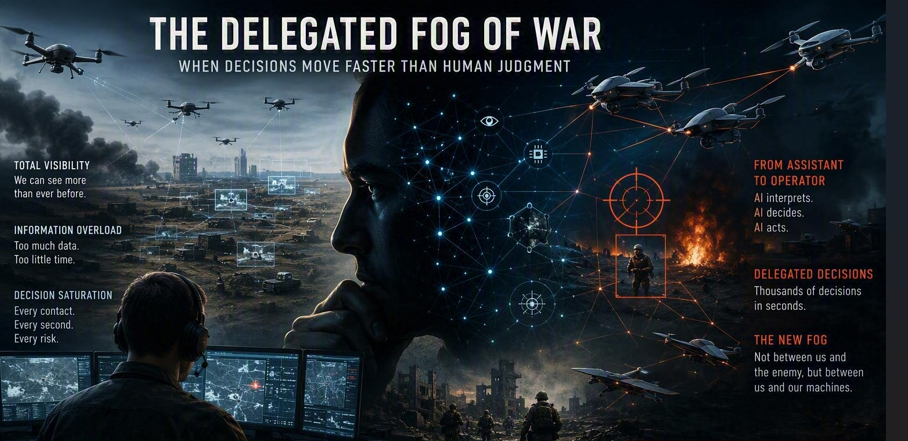
And this creates a paradox. The same technological revolution that made concentration excessively visible may also provide the tools necessary to make it possible again. Own sensors can provide a better understanding of the environment; artificial intelligence can process volumes of information beyond human capacity; electronic warfare can degrade enemy sensors; counter-UAS systems can reduce the threat posed by low-cost platforms; active protection systems can increase platform survivability; short-range air defense can protect the formation; decoys and deception can create uncertainty; dispersion can reduce vulnerability; and speed can allow concentration to remain brief enough to produce an effect before the adversary can react.
The maneuver of the future will not necessarily be the maneuver of the twentieth century.
It will be maneuver designed to exist inside a battlefield that will never become invisible again.
Speed, Concentration and Fog
For centuries, maneuver was associated with three fundamental elements: speed, concentration, and surprise.
Digital warfare does not eliminate these principles. It transforms them.
Speed is no longer simply the speed of a vehicle. It is the speed of the entire system: the ability to detect, understand, and act before the adversary.
Concentration does not necessarily mean assembling large masses of forces for long periods. It may mean concentrating effects for extremely short periods, generating local superiority before dispersing again.
And surprise does not necessarily require the adversary to see nothing. It may consist of the adversary seeing but failing to understand — receiving accurate information and nevertheless constructing the wrong interpretation; having functioning sensors but a decision-making system that is too slow; knowing where we are but being unable to determine which of our multiple actions represents the real threat.
The fog of war, therefore, does not disappear. It transforms again.
And it can be deliberately produced.
It can become an instrument of maneuver.
The Return
Military history does not advance by eliminating the past. It transforms it.
Firearms did not eliminate the need for movement. The machine gun did not eliminate the offensive. The tank did not eliminate defense. The missile did not eliminate the need to occupy territory.
Each revolution changed the conditions under which those functions could be performed.
The digital era is doing the same.
For a period, the sensor revolution produced an imbalance that favored the defense and made concentration extremely costly. The technological response is beginning to work on that imbalance — not to achieve zero risk, because that never existed, but to restore a level of risk that makes movement acceptable again.
When the risk of remaining stationary becomes greater than the risk of moving, maneuver will return.
It will not be a return to the past. It will be the natural consequence of a new technological equilibrium.
Because warfare cannot remain indefinitely in a condition where everyone can see, everyone can attack, and nobody can advance.
Maneuver does not need the battlefield to become invisible again.
It needs forces to become capable of surviving long enough to cross it.
And perhaps that is the real paradigm shift of twenty-first-century warfare:
not the disappearance of maneuver, but its adaptation to a battlefield defined by speed.
------
Author Biography
Diego Bavio is anArgentine defense and security analyst specializing in military innovation,logistics, and transnational security in Latin America. He holds a Bachelor'sdegree in Security Sciences and developed the Military Learning Velocity(MLV)framework, which examines how the speed of organizational learning isbecoming a decisive factor in modern warfare. His research also focuses ontransnational criminal ecosystems, military adaptation, and regional securitydynamics.