Nowhere to Hide: How Ukraine’s Shark Drone Hunted Down a Russian Irbis Radar

Modern warfare is increasingly defined not by who shoots first, but by who sees first. On a recent battlefield in Ukraine, that reality played out with brutal precision when operators of the 43rd Separate Artillery Brigade detected a Russian Irbis radar station, tracked its every move, and eliminated it before it could escape.
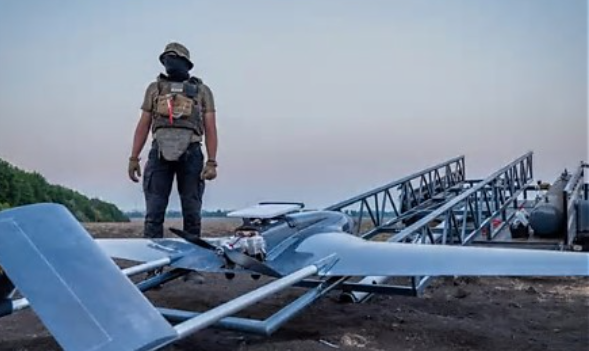
The operation began high above the front lines, where Ukrainian aerial reconnaissance crews were conducting surveillance using advanced unmanned systems. Among them was the Shark reconnaissance drone, a platform that has become one of Ukraine's most effective eyes in the sky. Built specifically for deep battlefield observation, the drone's mission is simple: find the enemy before the enemy knows it has been found.
This time, the target was an Irbis radar station, a critical component of Russia's battlefield surveillance and air defense network. Radars of this type help detect threats, coordinate defensive systems, and provide valuable situational awareness to military commanders. Losing one is not just a tactical setback. It creates blind spots, weakens defensive coverage, and forces commanders to operate with less confidence.
The radar crew clearly understood the danger.
After being detected, the Russian operators attempted what has become a familiar battlefield ritual: relocate immediately and disappear before Ukrainian fires arrive. In previous wars, that strategy often worked. A target could move, hide, and survive.
Today's battlefield is different.
The Ukrainian reconnaissance team did not simply discover the radar. They maintained continuous visual surveillance. Every movement was observed. Every kilometer was tracked. Every attempt to escape became part of a live intelligence picture.
What happened next demonstrates the growing integration of Ukrainian reconnaissance and strike capabilities.
The drone operators passed the target coordinates to a neighboring combat unit. The information moved rapidly through a battlefield ecosystem increasingly connected by digital communications, real-time intelligence sharing, and precision targeting processes. By the time the radar crew attempted to relocate, their fate had effectively already been decided.
Moments later, the strike arrived.
The Irbis radar system was destroyed.
The incident highlights one of the most important lessons emerging from the war in Ukraine: mobility alone is no longer enough. For decades, the basic principle of survival for high-value military assets was simple. Move quickly and frequently. Avoid detection. Disappear before enemy fire arrives.
But against persistent aerial surveillance, disappearing has become exponentially harder.
A drone does not get tired. It does not blink. It does not lose concentration after hours of observation. Once a target is identified and classified, the challenge is no longer finding it. The challenge becomes escaping an uninterrupted chain of detection, tracking, coordination, and destruction.
That chain is precisely what Ukraine has spent years developing.
Reconnaissance drones such as Shark are not weapons in the traditional sense. They carry no missiles and drop no bombs. Yet their impact on the battlefield is often just as decisive. They transform artillery from an area-effect weapon into a precision instrument. They shorten the kill chain. They remove uncertainty.
Most importantly, they deny the enemy the ability to hide.
For Russian crews operating valuable assets near the front line, that reality creates a constant dilemma. Every radar activation can reveal a position. Every movement can be monitored. Every relocation can become a route to destruction.
The destruction of the Irbis radar is therefore more than a single battlefield success. It is a vivid illustration of a new era of warfare, where information superiority can be more lethal than firepower itself.
On today's battlefield, the first side seen is often the first side lost.
And when a Shark is in the sky, the hunt may already be over.