No CGI, No Concept Render: Skydio’s F10 Is Already Flying — and That Changes the Conversation
In advanced robotics and aerospace, one of the hardest questions is often the simplest:
Is it real?
Not rendered.
Not simulated.
Not a prototype shown from one carefully selected camera angle.
Real.
That is exactly the point John Santry of Skydio is making about the new F10 Lightrunner.
His message is unusually direct:
“No CGI. Every part of the F10 Lightrunner is 100% real.”
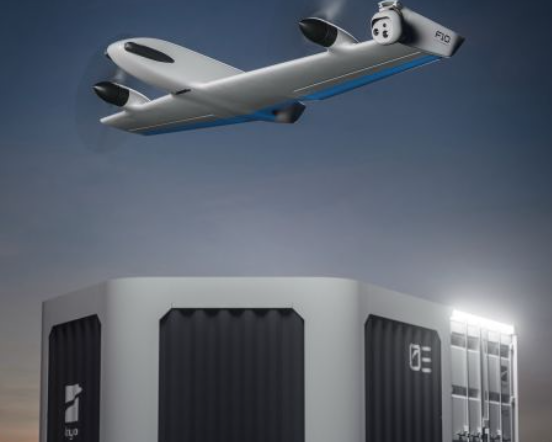
According to Santry, that includes the aircraft itself, the MegaDock, the robotic arm, the software stack and the SideEye gimbal. He also says hundreds of people flew the system in the Las Vegas desert during the week.
That matters because the robotics industry has become increasingly good at creating impressive demonstrations.
But there is a huge difference between something that looks convincing in a launch video and something that can be placed in front of hundreds of users and repeatedly operated in the real world.
The F10 story is therefore not just about a new drone.
It is about product maturity.
Hardware you can touch changes the story
The phrase “No CGI” sounds almost defensive, but it reveals something important about the state of the market.
Autonomous systems are often introduced through polished digital imagery, animation or tightly controlled demonstrations. That is understandable. Complex hardware takes time to build, and early concepts are difficult to communicate without visualization.
But once the real system exists, the standard changes.
Customers no longer have to imagine the product.
They can fly it.
They can watch the robotic arm move.
They can see how the dock works.
They can test the software.
They can evaluate the camera system under actual operating conditions.
That shift from concept to physical experience is one of the most important transitions in any hardware company.
The system matters more than the aircraft
What is especially interesting about Santry’s statement is that he does not focus only on the F10 aircraft.
He lists the MegaDock, Robot Arm, Software and SideEye gimbal separately.
That highlights Skydio’s broader ambition.
The product is not simply a drone.
It is an integrated robotic system.
The aircraft flies. The dock stores and supports it. The robotic arm interacts with it. The software controls the mission. The gimbal provides the visual perspective.
Individually, each element is useful.
Together, they create something more strategically important: an operational platform.
That is the direction many robotics companies are moving toward.
The value is shifting from a single machine to the complete ecosystem around the machine.
Why hundreds of users matter
The claim that hundreds of people flew the F10 in the Vegas desert is arguably more interesting than any specification.
Why?
Because large-scale hands-on use exposes weaknesses quickly.
A system can perform perfectly for its own engineering team and still fail when unfamiliar users interact with it.
Buttons are misunderstood.
Interfaces confuse people.
Hardware breaks in unexpected ways.
Workflows that looked obvious during development suddenly become frustrating.
Putting a system in front of hundreds of users creates a completely different level of validation.
It does not prove that every problem is solved.
But it does suggest that Skydio is far beyond the “beautiful prototype behind glass” stage.
The credibility gap in robotics
This matters across the robotics industry.
Investors, customers and governments are increasingly skeptical of impressive visuals alone.
The industry has seen enough concept renders, limited demos and ambitious roadmaps.
What buyers increasingly want is evidence of operational reality.
Can it work outside?
Can unfamiliar people use it?
Can it be deployed repeatedly?
Can the hardware survive real-world conditions?
Can the software support real missions?
That is why “No CGI” is more than a marketing line.
It is a challenge to the rest of the industry.
Skydio is effectively saying:
Don’t judge the product by the launch video. Come fly it.
And in a market crowded with future promises, that may be one of the strongest messages a robotics company can send.
The future is impressive.
But hardware that already works today is even more convincing.