Germany's Digital Brigade Just Passed Its First Real Test. The Bigger Battle Starts Now.
For decades, European armies modernized platforms.
Better tanks.
Better radios.
Better armored vehicles.
But modern warfare has exposed a difficult reality: being connected often matters as much as being armed.
This is why Germany's recent milestone in the Digitalisierung Landbasierte Operationen (D-LBO) program deserves attention far beyond the Bundeswehr.
It is not simply another procurement success story.
It may represent the beginning of Germany's transition from an industrial-age army into a truly networked digital force.
Victory in Modern Warfare Begins With Information
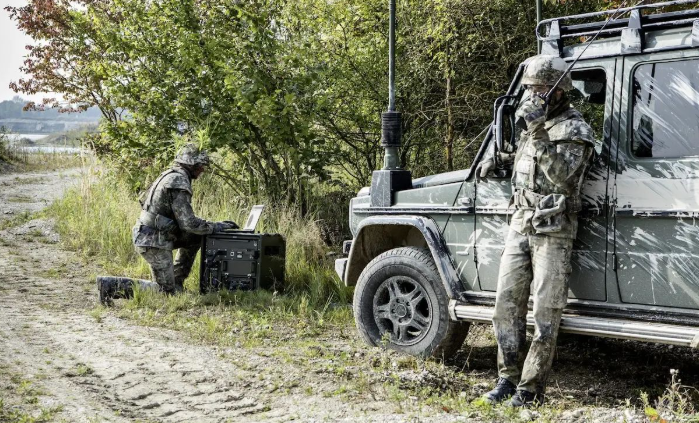
The recent operational evaluation of D-LBO Basic in Munster successfully tested the system in realistic tactical conditions, including live-fire exercises. According to the Bundeswehr, the fundamental functionality of the system has been validated.
At first glance, this sounds technical.
In reality, it addresses one of the most important military challenges of the 21st century.
Modern military forces no longer fight as collections of individual vehicles.
They fight as networks.
A tank that cannot share information rapidly becomes blind.
A brigade that cannot communicate securely becomes vulnerable.
A force that cannot integrate data across platforms loses operational tempo.
The war in Ukraine has repeatedly demonstrated that information superiority increasingly determines battlefield effectiveness.
D-LBO is Germany's answer to this reality.
The End of the Analog Battlefield
General Lieutenant Christian Freuding summarized the significance when describing the outcome of the testing: units can now drive, communicate, and engage targets digitally, with improved resilience against interference and increased communication range.
Those capabilities may sound incremental.
They are not.
For decades, many military communication architectures evolved through layers of legacy systems.
Digital transformation in military organizations is far more complicated than introducing a new software application.
Every vehicle.
Every sensor.
Every command post.
Every radio network.
Every battlefield management system must communicate reliably under combat conditions.
And unlike commercial technology, failure is not measured in lost productivity.
Failure is measured in operational effectiveness and potentially lives.
The Hardest Part Is Scale
The most revealing detail in the D-LBO story is neither the testing success nor the new technology.
It is the scale.
According to the Bundeswehr, more than 2,000 vehicles have already undergone conversion to D-LBO Basic standards. The target remains approximately 2,700 converted vehicles by the end of 2026.
That number reveals the real challenge.
Innovation is easy.
Transformation is difficult.
Defense ministries around the world regularly demonstrate prototypes.
Few manage to integrate those solutions across entire force structures.
A digital brigade is impressive.
A digital army is transformational.
The difference lies in execution.
NATO's Digital Deadline
The timing is not accidental.
The digitally enabled brigade led by Panzergrenadierbrigade 37 forms part of Germany's commitment to NATO's Forward Land Forces structure. The capability is expected to support operational readiness beginning in January 2027.
This reflects a broader trend visible across NATO.
The alliance is no longer focused solely on modernizing equipment.
It is focused on connecting equipment.
Interoperability, data exchange, resilient communications, and integrated command-and-control systems increasingly define combat power.
The most advanced platform means little if it operates in isolation.
Future military effectiveness depends on how well entire formations share, process, and act upon information.
The Real Revolution Is Organizational
Perhaps the most interesting aspect of the D-LBO program is not technological at all.
The Bundeswehr describes it as one of the most complex modernization efforts in its history, compressing a process that traditionally might require 10 to 15 years into a significantly shorter timeframe.
That requires more than technology.
It requires cultural change.
Training must evolve.
Doctrine must adapt.
Maintenance systems must modernize.
Operators must trust digital tools.
Organizations must become comfortable introducing, testing, improving, and deploying technologies simultaneously rather than sequentially.
That is often the hardest transformation of all.
Beyond Digitalization
The successful D-LBO evaluation marks an important milestone.
But it is best viewed as a beginning rather than an end.
The future battlefield will increasingly depend on connected sensors, resilient communications, AI-supported command systems, digital logistics, autonomous platforms, and integrated multinational operations.
Digitalization is not the final objective.
It is the foundation upon which every future capability will depend.
Germany's digital brigade may have passed its first major test.
The real challenge now is proving that an entire military can move at digital speed.