From Prototype to Production: Germany Is Getting Serious About Laser Drone Defence

For years, laser weapons have lived in a comfortable world of prototypes, trials and spectacular demonstrations.
In Hannover, that may be starting to change.
INLEAP Photonics has opened a new production facility and is moving from prototype development toward industrial serial production of laser-based counter-drone systems. The company says the production ramp-up and further deliveries will begin in November 2026.
And that transition matters.
The decisive question surrounding directed-energy weapons is no longer simply whether a laser can destroy a drone. Demonstrators have been proving aspects of that proposition for years.
The harder question is: Can Europe manufacture operationally useful laser systems in meaningful numbers?
INLEAP now wants to provide an answer.
The laser weapon enters the factory
The Hannover company, a spin-off from Laser Zentrum Hannover, has created a manufacturing line based on the one-piece-flow principle. Each system moves through six coordinated production stations without intermediate storage.
That sounds like manufacturing jargon. Strategically, it is anything but.
A weapon that works once on a test range is a technology demonstration. A weapon that can be manufactured repeatedly, delivered, maintained and scaled to meet military demand starts becoming an industrial capability.
INLEAP plans significant expansion alongside the production ramp-up. According to the information released for the opening, its workforce of roughly 50 employees is expected to grow to more than 100 by the end of 2027.
The first turnkey units from production are destined for partner STARK, following the companies’ counter-drone partnership announced at Hannover Messe 2026.
FASTLIGHT HELD: AI meets directed energy
At the centre of the programme is INLEAP FASTLIGHT HELD, with HELD standing for High Energy Laser Drone.
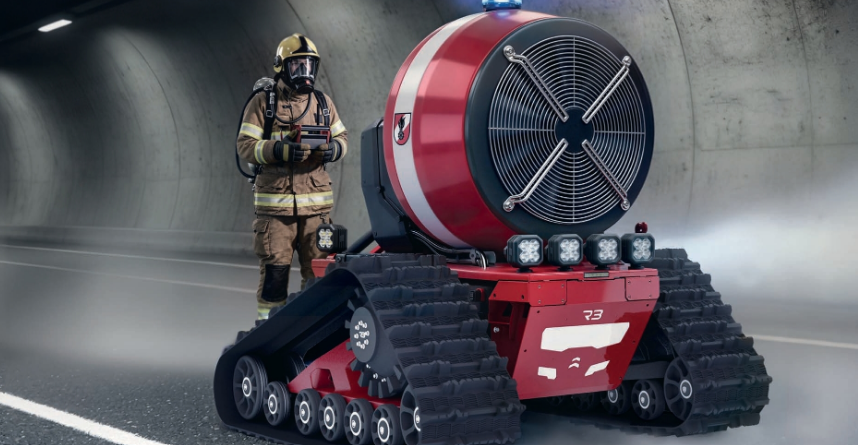
The concept combines an uncrewed, all-terrain ground platform with laser-based engagement technology. It is intended to provide remotely operated protection for mobile forces, temporarily secured areas and critical infrastructure.
But brute laser power is only half the story.
The system combines AI-assisted detection with rapid laser beam steering. Its software is intended to identify vulnerable points on an approaching drone and keep the beam accurately directed even while the target manoeuvres.
The objective is simple: hold sufficient energy on the right part of the aircraft long enough to neutralise it within seconds.
In modern counter-drone warfare, that targeting problem can be as important as the laser itself.
From Laserdome to production
The production announcement follows another important demonstration.
Together with the Cyber Innovation Hub of the Bundeswehr, INLEAP recently demonstrated laser-based drone defence at Strausberg airfield under the Laserdome project. According to the project reporting, the demonstration brought laser counter-drone capability onto a public airport environment.
Sven Weizenegger, head of the Bundeswehr Cyber Innovation Hub, distilled the concept neatly: the laser provides the effect, while AI-supported software provides the precision.
Now comes the difficult part: scale.
The economics of shooting down cheap drones
That could ultimately be where lasers become genuinely disruptive.
Militaries face an uncomfortable equation. Relatively inexpensive unmanned aircraft can force defenders to deploy sophisticated detection systems and, in some circumstances, considerably more expensive interceptors.
Directed energy promises another approach.
Rather than launching a new physical interceptor for every engagement, a laser generates its effect through energy delivered onto the target. That does not make a laser system free, nor does it eliminate limitations such as power requirements, weather, visibility, range or thermal management.
But it could fundamentally change the economics of certain short-range counter-drone engagements.
And INLEAP’s Hannover facility highlights another strategic dimension: European production capacity.
Europe does not merely need clever defence prototypes. It needs technologies that can survive the transition from laboratory to production line, from successful demonstration to repeatable manufacturing, and ultimately from dozens of systems to potentially much larger fleets.
That is why the most interesting thing about INLEAP’s announcement may not be the laser at all.
It is the factory behind it.
The counter-drone laser has already been demonstrated. Now Germany is testing something potentially harder: whether it can build it at scale.