From Dublin to Dallas: How Manna Aero Is Building Drone Delivery That Actually Scales

Convenience has trained us well. Tap a screen, place an order, wait. And wait. And wait some more—until your food arrives lukewarm, carried by a delivery driver trapped in traffic at the mercy of urban sprawl.
Manna Aero thinks this entire ritual is broken.
Founded in Dublin in 2018, the Irish drone delivery company isn’t chasing sci‑fi fantasies or viral tech demos. Its ambition is far more disruptive—and far less glamorous. Manna isn’t selling drone delivery. It’s selling logistics.
“We’re not selling drones,” CEO Bobby Healy says flatly. “We’re selling logistics.”
That distinction explains why Manna has quietly scaled from Irish suburbs to Finnish cities and into the United States, operating in places like Dallas and Oklahoma while much of the drone industry remains stuck in pilot programs and press releases.
Three Minutes, No Traffic
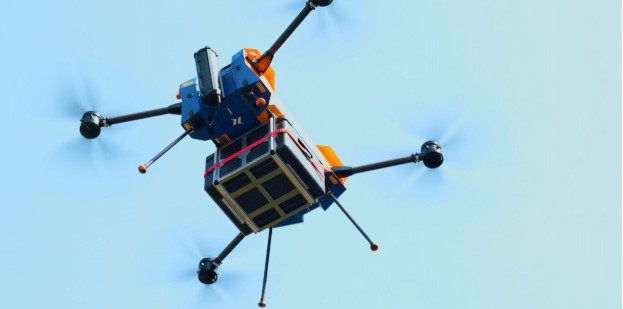
Manna’s service is disarmingly simple. Order food or goods through a familiar delivery app. Drop a pin. Three minutes later, a drone hovers about ten feet above the ground and lowers your order gently by tether.
No traffic. No idling engines. No missed doorbells.
The drones can carry up to 8.5 pounds, which means this isn’t just about pizza and pad thai. Manna delivers groceries, pharmacy items, and everyday essentials—anything that fits within the weight limit.
The real unlock, though, isn’t the aircraft. It’s the business model.
Manna integrates directly with existing delivery platforms and local vendors. No new apps. No customer acquisition costs. No marketing spend. When Manna enters a city, demand already exists.
“Everyone can use us through the delivery apps,” Healy explains. “We don’t need to sign up customers. We put aircraft in the air, and they go straight to work.”
One drone can complete roughly eight deliveries an hour. Multiply that by ten aircraft, and Manna hits full utilization almost immediately. It’s less Silicon Valley moonshot and more low-cost airline economics—precise, repeatable, relentless.
Manufacturing Where You Fly
Scaling across continents brings regulatory friction, but Manna has turned that challenge into a competitive advantage. Instead of outsourcing drone manufacturing, the company builds its aircraft locally in the regions where it operates.
In the United States, that decision matters. Domestic manufacturing accelerates regulatory approval and deployment, allowing Manna to move faster than competitors shipping aircraft across borders and paperwork queues.
It’s a pragmatic choice—one that reflects Manna’s broader philosophy. This isn’t about flashy hardware. It’s about operational speed.
Regulation as Collaboration, Not Combat
Drone regulation is often framed as a bottleneck. Manna treats it as a partnership.
The company already holds approvals for beyond visual line of sight (BVLOS) operations over densely populated areas and even highways. Recently, U.S. FAA Administrator Bryan Bedford visited Manna’s facilities, underscoring the collaborative approach between regulators and operators.
“I don’t think there’s a better or worse regulator,” Healy says. “There’s a readiness and willingness to work together.”
That mindset extends to competitors. Manna has shared airspace and integrated UTM systems with rivals like Wing, flying in close coordination rather than defensive isolation.
“It’s a very unusual industry,” Healy admits. “We cooperate. We share. And that lifts everyone.”
Winning Over the People Below
Perhaps most surprising is how Manna approaches the communities beneath its flight paths.
Before launching in a new area, the company engages local governments, schools, and residents. And when concerns arise—as they inevitably do—Manna doesn’t deflect. It listens.
The result? In Ireland, 62 percent of households in service areas now use the platform. Demand has grown so strong that residents have petitioned the government to expand Manna’s operations, helping spur the creation of a national drone framework.
That’s not disruption by force. It’s adoption by trust.
The Unsexy Future of Delivery
For Healy, the endgame isn’t domination—it’s discipline.
“The winner in this space will understand how to scale a low-cost airline,” he says. “It’s not sexy. It’s safe, efficient, and pragmatic.”
And that may be exactly why Manna is succeeding where others stall. While the industry debates the future, Manna is already delivering it—quietly, efficiently, and three minutes at a time.