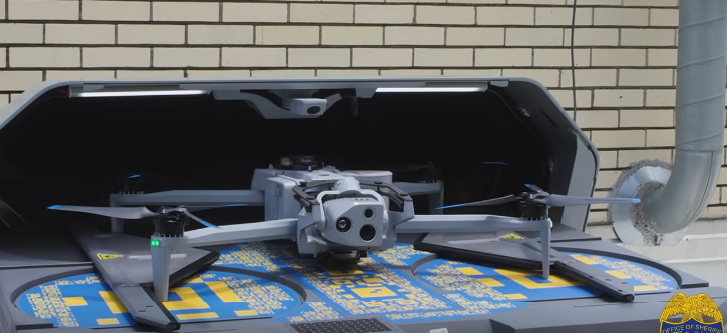
Eyes Above the Streets: The Drone That Turned an Ambush Into a Survival Story

The debate about drones often begins in the wrong place.
People ask whether drones are replacing police officers, deputies, or first responders. They imagine autonomous machines taking over human decisions, turning public safety into a science-fiction experiment.
But the reality emerging in American law enforcement is far more practical and, arguably, far more important.
Drones are not replacing people.
They are replacing guesswork.
That distinction became brutally clear on July 16 in Hillsborough County, Florida, during a violent confrontation that demonstrates both the promise and limitations of modern public safety technology.
Deputies responded to a report that a woman had allegedly been held at gunpoint overnight by her former boyfriend. The suspect was reported to be armed and was known to be a convicted felon. As law enforcement arrived on scene, a patrol drone was already observing the area from above.
What followed was every officer's nightmare.
The suspect opened fire.
Two deputies were shot and wounded.
The drone did not stop the ambush.
It did not magically neutralize the threat.
It did not make the situation safe.
But according to Hillsborough County Sheriff Chad Chronister, the aerial platform provided something that became critical in the chaos of those moments: accurate, real-time information.
While gunfire erupted on the ground, a master sergeant monitoring the drone's live video feed knew exactly where the shooter was positioned. That information enabled a rapid response that stopped the attack.
Most importantly, both wounded deputies survived.
The incident highlights a fundamental transformation taking place in emergency response.
For decades, first responders arriving at dangerous scenes often entered with incomplete information. Officers relied on witness statements, radio transmissions, fragmented reports, and limited visibility. Decisions had to be made within seconds using whatever information happened to be available.
The consequences could be fatal.
A suspect hidden behind a building.
A weapon unseen from street level.
A victim trapped out of sight.
An officer walking unknowingly into an ambush.
Every one of these situations is made more dangerous by uncertainty.
Drones attack that uncertainty directly.
Their value is not that they eliminate risk. Their value is that they reduce the number of unknowns.
That distinction matters because public discussions about emerging technologies often swing between hype and fear. Supporters sometimes portray drones as miracle solutions. Critics envision constant surveillance and unchecked government monitoring.
The truth sits somewhere in the middle.
Even Sheriff Chronister is careful not to oversell the technology.
His argument is refreshingly honest. Drones are tools, not superheroes. They are intended to improve situational awareness, not eliminate danger. Human judgment remains essential. Human accountability remains essential. Human decision-making remains essential.
At the same time, public concerns about privacy cannot simply be dismissed.
Trust is the fuel that keeps public safety innovations operational.
Without trust, even the most effective technology becomes controversial.
That is why Hillsborough County's approach may prove as important as the technology itself. Officials point to legal restrictions governing drone deployments, strict data security requirements, prohibitions against weaponized drones, and policies governing how footage is retained and managed.
These safeguards are not bureaucratic obstacles.
They are the foundation of legitimacy.
The future of public safety technology will depend not only on what drones can do, but on how transparently agencies explain their use.
Citizens want safer communities.
They also want accountability.
The agencies that succeed will be those capable of delivering both.
The July ambush serves as a powerful reminder of what is truly changing.
Drones are not replacing deputies.
They are giving them a clearer picture of the battlefield they already face every day.
In policing, seconds matter.
Information matters.
Visibility matters.
And increasingly, the difference between tragedy and survival may be a pair of eyes in the sky.