Europe's Defense Paradox: Everyone Agrees on Cooperation. So Why Is Fragmentation Still Winning?
European defense has entered an uncomfortable phase.
Nobody disputes the threat environment.
Nobody questions the need for greater readiness.
Nobody argues against cooperation.
And yet Europe continues to struggle with one problem that has haunted it for decades:
Everyone supports cooperation. Nobody wants dependency.
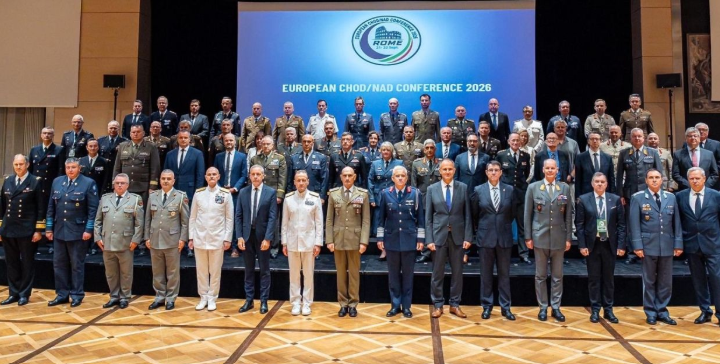
The recent gathering in Rome of European Chiefs of Defence (CHODs) and National Armaments Directors (NADs), hosted by Italy and supported by the European Defence Agency (EDA), highlighted a growing consensus across the continent. The security environment has fundamentally changed. The era of assuming that major land warfare was a thing of the past is over.
The challenge now is translating strategic awareness into military capability.
That sounds simple.
It is not.
Europe's armed forces collectively spend hundreds of billions of euros annually. European defense industries produce world-class systems. European militaries possess highly capable personnel.
Yet Europe frequently struggles to convert these strengths into coherent military power.
The reason is structural.
Defense remains national.
Threats are increasingly transnational.
This creates a contradiction at the heart of European security.
Each country wants strategic autonomy.
Collectively, they need strategic integration.
For decades, the balance tilted toward national preferences. Multiple tank programs, multiple fighter programs, multiple naval projects, and fragmented procurement structures became the norm.
That approach may have been politically comfortable.
Today's security environment has made it strategically expensive.
The war in Ukraine has accelerated an uncomfortable realization.
The speed of modern warfare is increasingly outpacing traditional procurement cycles.
A nation can no longer spend fifteen years debating requirements while adversaries adapt in months.
Military advantage is becoming increasingly linked to the ability to cooperate, scale production, integrate technologies, and field capabilities rapidly.
In this context, the significance of meetings such as the CHOD and NAD conference extends beyond diplomacy.
The real issue is industrial capacity.
The real issue is interoperability.
The real issue is whether Europe can transform twenty-seven national defense priorities into a coherent military ecosystem.
That is where the annual defense readiness reviews and the Coordinated Annual Review on Defence (CARD) become strategically important.
Historically, European defense discussions often focused on capabilities.
Today, the focus is shifting toward capability gaps.
The distinction matters.
The question is no longer simply what capabilities exist.
The question is whether those capabilities can be generated at sufficient scale, sustained over time, and integrated across allied forces.
Modern warfare increasingly rewards mass, adaptability, and learning speed.
A fragmented force structure struggles to achieve any of those objectives.
This creates a second paradox.
Europe possesses some of the most technologically advanced defense companies in the world.
Yet the future challenge may not be technological.
It may be organizational.
The military lessons emerging from Ukraine suggest that learning speed is becoming just as important as technology itself.
Innovation now spreads rapidly.
Drones proliferate.
Artificial intelligence diffuses.
Electronic warfare techniques evolve continuously.
No military advantage remains exclusive for long.
Under these conditions, success depends less on who develops technology first and more on who adapts fastest.
The same principle applies to defense institutions.
Can Europe learn faster?
Can Europe procure faster?
Can Europe cooperate faster?
Can Europe field capabilities before strategic circumstances change again?
These questions are becoming increasingly urgent.
Because military competition is no longer solely about capability.
It is about velocity.
Velocity of production.
Velocity of innovation.
Velocity of adaptation.
Velocity of cooperation.
The Rome discussions suggest that European leaders increasingly understand this reality.
The challenge begins after the meetings end.
Declarations are easy.
Integration is difficult.
Every collaborative program requires compromises on sovereignty, industrial interests, budgets, and political priorities.
That is precisely why cooperation has historically progressed more slowly than security challenges.
Yet current geopolitical realities are reducing Europe's room for hesitation.
The next decade may determine whether Europe evolves from a collection of highly capable national militaries into a genuinely integrated defense ecosystem.
If successful, Europe could generate military power far greater than the sum of its individual parts.
If not, fragmentation may remain the continent's most persistent strategic vulnerability.
The question is no longer whether Europe should cooperate.
That debate is over.
The real question is whether Europe can move faster than the threats it faces.
And in modern defense, speed may be the most important capability of all.