eBee VISION by EagleNXT: From U.S. Army Skies to the Amazon — Is Latin America Next?

Winning a contract with the U.S. Army is not just a milestone — it’s validation.
With the deployment of eBee VISION, EagleNXT has positioned itself inside one of the most demanding military ecosystems in the world. But the bigger story is not the contract itself.
It’s what comes next.
Because while the drone is heading into U.S. Army training programs, EagleNXT is already looking far beyond — toward a region where conditions are less predictable, infrastructure is limited, and performance is tested not in simulations, but in reality.
Latin America.
And this is where things get interesting.
A Different Battlefield
Latin America is not a uniform market. It is a complex mix of jungles, mountains, deserts, and rapidly evolving security needs. From the dense canopy of the Amazon to the narrow valleys of the Andes, this is terrain that actively works against technology.
Signals degrade. Visibility drops. Mobility becomes a challenge.
Most drones struggle here.
eBee VISION is built for it.
Designed to operate in GNSS-denied environments, the system relies on advanced imaging and real-time navigation tools rather than depending solely on GPS. This is critical in regions where signal obstruction is not an exception — it is the norm.
In places where traditional ISR systems fail, this is where eBee VISION starts working.
Portability as a Strategic Advantage
One of the defining features of eBee VISION is not raw power — it’s mobility.
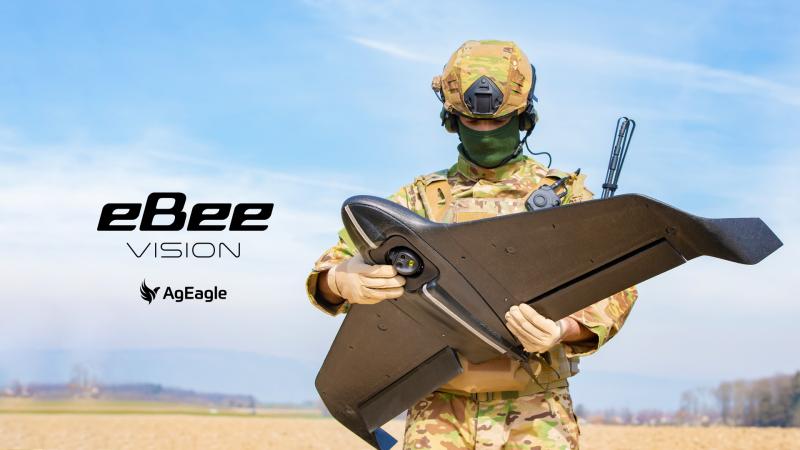
At just 1.8 kg, with a wingspan of 118 cm, the system is fully person-portable. It fits into a backpack, deploys in under three minutes, and can be operated by small units without logistical support.
This changes how ISR is used.
Instead of relying on large, centralized systems, intelligence gathering becomes distributed, immediate, and flexible. Small patrol teams can carry their own aerial awareness into remote regions — whether that’s a jungle clearing, a mountain ridge, or a desert outpost.
In Latin America, that’s not a feature.
That’s a requirement.
Seeing What Others Miss
Equipped with 32x optical zoom and thermal imaging, eBee VISION is not just about flying — it’s about seeing clearly in complex environments.
This has direct implications for real-world operations:
- Detection of clandestine narcotics labs hidden under dense vegetation
- Identification of illegal airstrips in remote regions
- Monitoring of insurgent movement in rugged terrain
- Surveillance in low-visibility or night conditions
It transforms ISR from passive observation into actionable intelligence.
And it does so in real time.
From Training Tool to Operational Asset
The current U.S. Army contract focuses on training and operator readiness. But this is not a limitation — it’s a strategic entry point.
eBee VISION is already being used in OPFOR training scenarios, simulating real-world ISR conditions and enabling data-driven mission planning. It provides high-resolution live feeds for immediate feedback and tactical alignment.
In other words, it’s shaping how soldiers think about drones.
And once a system becomes part of doctrine, its role rarely stays limited.
Latin America: The Next Move
EagleNXT is not waiting.
The company is actively engaging with multiple Latin American countries, with demonstration events planned in Paraguay and partnerships already established across Brazil, Colombia, Argentina, and Peru.
This is not market exploration.
It’s positioning.
Because Latin America represents a unique convergence of needs:
- Challenging terrain
- Growing demand for ISR capabilities
- Increasing focus on border control and internal security
- A mix of domestic production and international procurement
To succeed here, a drone must do more than perform.
It must adapt.
The Real Question
The question is no longer whether eBee VISION works.
The U.S. Army contract answers that.
The real question is whether EagleNXT can translate that credibility into dominance in a region where conditions are harsher, competition is rising, and expectations are higher.
If it can, Latin America won’t just be the next market.
It will be the proving ground.