31,398 Robot Missions in One Month: Is America Ready to Sustain the Next Long War?

The most important number in military robotics this year may not be the price of a new autonomous vehicle.
It may be 31,398.
That is how many logistics and evacuation missions Ukrainian forces conducted with unmanned ground vehicles in October 2026. More than 1,000 missions every day. Ukraine’s Ministry of Defence says every mission was recorded in the DELTA combat system and verified by Brave1 specialists.
Even more striking is the trajectory.
Ukraine went from 7,511 UGV missions in January to 31,398 in October, more than quadrupling monthly employment. Over the first ten months of 2026, Ukrainian units conducted more than 171,000 UGV missions.
This is no longer experimentation.
It is logistics.
And that distinction should make Washington uncomfortable.
Ukraine is solving a battlefield problem, not showcasing technology
The modern battlefield punishes movement.
Resupply vehicles can be detected. Casualty evacuation routes are observed. Drones and artillery make concentration dangerous. Electronic warfare attacks communications.
Ukraine has responded by increasingly sending machines where sending people has become too dangerous.
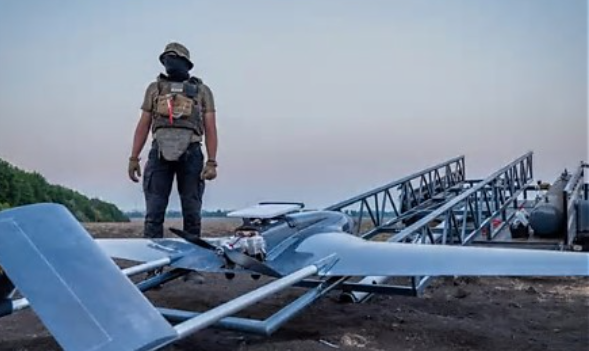
UGVs carry ammunition, food and water. They also evacuate casualties. By August, Ukraine had already contracted more than 22,000 UGVs, nearly twice the total for all of 2025.
The transformation extends beyond ground vehicles. Ukraine's Ministry of Defence says heavy aerial drones have also begun evacuating wounded personnel when mined, blocked or exposed roads make ground evacuation impossible.
That is the real lesson: robotics is becoming part of battlefield sustainment architecture.
America understands the problem
The U.S. Army is not ignoring this shift.
Its Infantry Last Tactical Mile initiative selected six companies, including Overland AI, Forterra, American Rheinmetall and HDT, to develop robotic systems for logistics, casualty evacuation and communications support. An operational assessment with an Army unit is planned for early 2027.
American military thinking is changing too.
A recent U.S. Army publication warns that the “golden hour” evacuation model developed under the air superiority enjoyed in Iraq and Afghanistan may be unrealistic in large-scale combat. Against sophisticated air defence, precision fires and pervasive electronic warfare, helicopter evacuation could become dramatically more difficult.
The conceptual problem is therefore increasingly understood.
The harder question is speed.
Twelve years versus battlefield speed
In July, the U.S. Government Accountability Office delivered a statistic far more troubling than any comparison of robot inventories.
The expected average time for major U.S. defence programs to deliver capability has risen to more than 12 years. GAO found continuing schedule delays and warned that even rapid acquisition pathways were sometimes being slowed by immature technologies.
Twelve years.
Ukraine's battlefield is changing in months.
Sometimes weeks.
That is the mismatch.
The United States can build extraordinarily sophisticated platforms. But prolonged warfare does not reward sophistication alone. It rewards the ability to manufacture, repair, modify and replace systems continuously while the enemy is simultaneously trying to destroy them.
A fleet of 1,000 robots is not a sustainable capability if 300 are broken, spare parts are unavailable and replacements take months.
The Pentagon therefore needs a different scoreboard.
Not:
How many prototypes performed well?
But:
How many systems reached operational units?
How many remain available after months of sustained use?
How quickly can damaged vehicles return to service?
How rapidly can factories replace battlefield losses?
And how quickly can software, communications and autonomy change when the enemy adapts?
GAO has described the broader acquisition problem bluntly: the United States repeatedly pours time and money into programs that “fail slow” while global technology accelerates.
Ukraine cannot afford to fail slowly.
A battlefield tends to impose deadlines more brutally than Congress does.
That may be the real warning contained in those 31,398 missions.
America could enter the next major war with the world's most technologically advanced military and still discover that technological superiority is not the same as wartime endurance.
Because long wars introduce a different equation:
What matters is not only what you can field on Day One.
It is what you can still repair, replace and produce on Day 1,000.