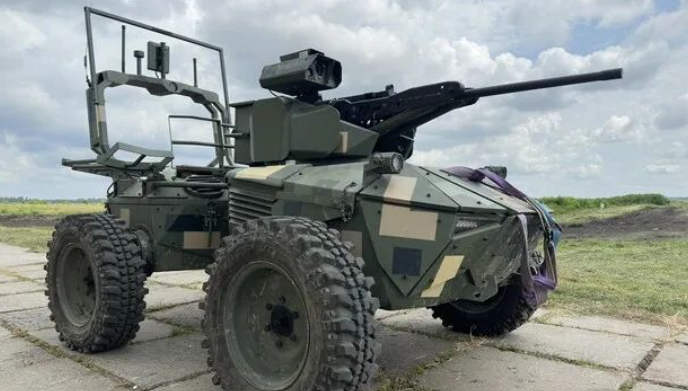
AZAK S26 - The Wheel That Kills the Vehicle And Rebuilds Mobility From Zero

Most vehicles are designed the same way: a central body, a drivetrain, and wheels as passive components. It’s a logic so deeply embedded in engineering that few question it.
AZAK S26 does.
And in doing so, it flips the entire concept of ground mobility on its head.
At first glance, the AZAK S26 looks like a compact unmanned ground vehicle (UGV) built for extreme terrain. But the real innovation is not what you see — it’s how it’s structured.
Each wheel is not just a wheel.
It is a complete propulsion system.
Motor, gearbox, inverter, battery — all integrated directly into the wheel itself. This transforms the architecture from centralized to fully distributed. The vehicle is no longer dependent on a single drivetrain. Instead, it becomes a modular system where every wheel contributes independently to movement, control, and power.
This is not just engineering.
It’s a paradigm shift.
The immediate advantage is obvious: torque and control. With independent wheel systems, AZAK S26 can dynamically adjust traction in real time. Climbing rocks, crossing water, or navigating unstable ground becomes not just possible, but predictable.
Each wheel reacts to terrain individually.
The result is a machine that feels less like a vehicle — and more like a system that adapts.
But the deeper innovation lies in logistics and usability.
Traditional UGVs are complex, heavy, and difficult to maintain in the field. If something fails, the system often needs to be returned for repair. AZAK takes a radically different approach.
Its QuickConnect system allows wheels to be attached or removed in seconds — no tools, no complex procedures. A damaged wheel is not repaired on-site. It is replaced.
This reduces downtime dramatically.
It also changes how fleets are managed. Instead of maintaining entire vehicles, operators can maintain modular components. Wheels become interchangeable units — charged, swapped, and redeployed as needed.
Think less “vehicle maintenance” and more battery swapping meets mobility.
This approach also enables something rarely achieved in rugged systems: true field adaptability.
Need more power? Swap wheels.
Need longer operation time? Use pre-charged units.
Need a different configuration? Rebuild on the spot.
The AZAK S26 is not a fixed machine. It is a platform.
And that platform extends into autonomy.
Because each wheel contains its own intelligence and communication capability, the system can be controlled centrally or operate in distributed modes. It can function as a single UGV, or as part of a coordinated system, depending on mission requirements.
This flexibility is critical in modern applications — from military logistics to industrial operations in remote environments.
But what makes AZAK S26 particularly compelling is its rugged honesty.
This is not a polished, over-designed product trying to look futuristic. It is unapologetically functional. Built for mud, rocks, water, and impact — not for showrooms.
And that is exactly why it works.
Because in real-world conditions, reliability beats beauty. Simplicity beats complexity. And modularity beats everything.
The implications go beyond one vehicle.
AZAK S26 suggests a future where mobility is no longer tied to fixed structures, but to intelligent, swappable modules. Where vehicles are assembled based on need, not predefined design. Where failure is not catastrophic — it is just another replaceable component.
It’s a shift from machines to systems.
From objects to capabilities.
And once you see it, it becomes hard to go back to the old way of thinking.


.jpg)